Many Muslims have told me there is only one Qur'an, and that it has been perfectly preserved, and that all Qur'ans around the world are identical. They have said to prove that the Qur'an is superior to the Bible. Maybe a Muslim has said this to you, or maybe you are a Muslim and have said this to others?
It is common for Muslims to believe this because this is what Islamic leaders teach.
No other book in the world can match the Qur'an [...]
The astonishing fact about this book of ALLAH is
that it has remained unchanged, even to a dot,
over the last fourteen hundred years. [...] No
variation of text can be found in it. You can
check this for yourself by listening to the
recitation of Muslims from different parts of
the world.
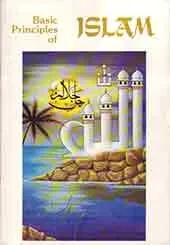
(Basic Principles of Islam, p. 4)
The above claim is that all Qur'ans around the world are
identical and that "no variation of text can be found".
In fact the author issues a challenge saying, "You can
check this for yourself by listening to the
recitation of Muslims from different parts of
the world". In this article I will take up this
challenge and see if all Qur'ans are identical.
CONTENTS
Some history related to the recitation of the Qur'an.
We begin by turning to an Islamic encyclopedia. This scholar explains an important aspect
of the history of the Qur'an. Please read this quote a few times if you
are new to this area of study.
Historically speaking, after the definitive recension of the Koran made at the command
of the Caliph 'Uthman, certain variant readings existed and, indeed, persisted
and increased as the Companions who had memorised the text died,
and because the inchoate Arabic script, lacking vowel signs
and even necessary diacriticals to distinguish between
certain consonants, was inadequate [...]
In the 4th Islamic century, it was decided to have
recourse to "readings" (qira'at) handed down from
seven authoritative "readers" (qurra'); in order,
moreover, to ensure accuracy of transmission, two
"transmitters" (rawi, pl. ruwah) were accorded
to each. There resulted from this seven basic texts
(al-qira'at as-sab', "the Seven readings"), each having
two transmitted versions (riwayatan) with only
minor variations in phrasing, but all containing meticulous
vowel-points and other necessary diacritical marks. [...]
The authoritative "readers" are:
Nafi` (from Medina; d. 169/785) Ibn Kathir (from Mecca; d. 119/737) Abu `Amr al-`Ala' (from Damascus; d. 153/770) Ibn `Amir (from Basra; d. 118/736) Hamzah (from Kufah; d. 156/772) al-Qisa'i (from Kufah; d. 189/804) Abu Bakr `Asim (from Kufah; d. 158/778)
(Cyril Glasse, The Concise Encyclopedia of Islam, 'Qira'ah', 4th ed. 2013, p. 436, bold added)
Therefore, the third caliph, Uthman, made a standard text of the Qur'an, and how this is recited has been passed down from men called the "readers" (Arabic: qurra'). The readers/qurra' were famous reciters of the Qur'an from the early centuries of Islam.
The way these men recited the Qur'an was formally recorded in textual form by other
men called the "transmitters".
There are more readers and transmitters than those listed above.
The table below lists the ten commonly accepted readers, their transmitted versions,
and their current area of use.
The Reader
The
Transmitter
Current Area of Use
"The Seven"
Nafi`
Warsh
Algeria, Morocco, parts of
Tunisia, West Africa and Sudan
Qalun
Libya, Tunisia and parts
of Qatar
Ibn Kathir
al-Bazzi
Qunbul
Abu `Amr al-'Ala'
al-Duri
Parts of Sudan and West Africa
al-Suri
Ibn `Amir
Hisham
Parts of Yemen
Ibn Dhakwan
Hamzah
Khalaf
Khallad
al-Kisa'i
al-Duri
Abu'l-Harith
Abu Bakr `Asim
Hafs
Muslim world in general
Ibn `Ayyash
"The Three"
Abu Ja`far
Ibn Wardan
Ibn Jamaz
Ya`qub al-Hashimi
Ruways
Rawh
Khalaf al-Bazzar
Ishaq
Idris al-Haddad
Abu Ammaar Yasir Qadhi, An Introduction to the Sciences
of the Qur'aan, 1999, p. 199.
This means there are many transmitted versions of the Qur'an. These are called "readings" (Arabic: qira'at), and each
is its own unique recitation.
If you recite or read the Qur'an it will
be according to one of these qira'at/readings.
Each of these has its own chain of narrators (isnad) like a hadith, and like hadiths, some are accepted while other rejected. We will now compare two of these Qur'ans.
A COMPARISON BETWEEN TWO ARABIC QUR'ANS
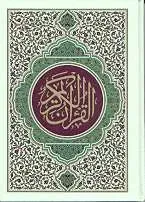
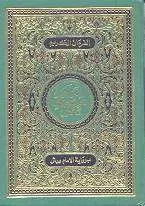
The Qur'an on the left is now the most
commonly used Qur'an. It is the 1924 Egyptian standard edition based on the qira'a of
Imam Hafs. The Qur'an on the right is according to Imam Warsh and
is mainly used in North Africa.
When we compare these Qur'ans we see five main types of differences between them.
Extra Words
Graphical/Basic Letter Differences
Diacritical Differences
Vowel Differences
Basmalah Difference
The following examples are scans of the same word/s in the
same verse from these two Qur'ans. On some occasions the verse number differs because the two Qur'ans
number their verses differently. There is a slight difference in script as well:
the letter Qaaf in the Warsh Qur'an is written with only one dot above,
and the Faa has a single dot below. This is the orthography of the North African (Maghribi)
Arabic script.
EXTRA WORDS
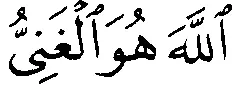
THE QUR'AN ACCORDING TO THE QIRA'A OF IMAM HAFS
THE QUR'AN ACCORDING TO THE QIRA'A OF IMAM WARSH
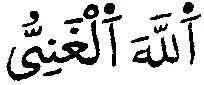
Allah huwa l-ghaniyu
Allah is the self-sufficient, Q57:24
Allah l-ghaniyu
Allah, the self-sufficient, Q57:23
The Hafs qira'a has an extra word, huwa, in this verse. This makes the grammar different between these
two Qur'ans. In the Hafs qira'a it is a sentence, Allah is the self-sufficient. While in the
Warsh qira'a it is a phrase, Allah, the self-sufficient. Both Qur'ans are expressing the same idea but
are doing it in different ways and as a result are recited differently.
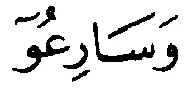
wasaari'uu
And hasten to, Q3:133
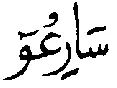
saari'uu
Hasten to, Q3:133
The Hafs qira'a has the extra word waw (and).
This does not change the meaning of the verse but does change the way it is recited.
GRAPHICAL/BASIC LETTER DIFFERENCES
THE QUR'AN ACCORDING TO THE QIRA'A OF IMAM HAFS
THE QUR'AN ACCORDING TO THE QIRA'A OF IMAM WARSH
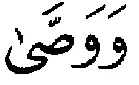
wawassaa
And Ibrahim enjoined on his sons, Q2:132
wa'awsaa
And Ibrahim instructed/made his sons, Q2:131
The Hafs qira'a is a 2nd form verb, while the
Warsh qira'a has an extra alif to make a 4th form verb. This intensifies the
meaning of the verb and changes how it is recited.
yartadda
turn back, Q5:54
yartadid
turn back, Q5:56
The two words are recited differently but have the same meaning.
They are two different examples of the 8th form jussive verb.
This is most likely a difference in dialect.
qaala
He said, "My lord knows", Q21:4
qul
Say: My lord knows, Q21:4
In the Hafs qira'a qaala is the perfect tense and therefore Muhammad
is the subject of the verb,
but in the Warsh qira'a qul is the imperative and therefore the subject is
God who is commanding Muhammad/Muslims. This difference is repeated in 21:112.
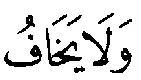
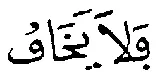
walaayakhaafu
and for him is no fear, Q91:15
falaayakhaafu
therefore, for him is no fear, Q91:15
There are different letters at the beginning of these
words. This changes the connection from "and" to "therefore".
DIACRITICAL DIFFERENCES
Arabic uses dots (i'jam) to distinguish
certain letters that are written the same way. For instance
the basic symbol
baa',
taa',
thaa',
nuun,
yaa'.
THE QUR'AN ACCORDING TO THE QIRA'A OF IMAM HAFS
THE QUR'AN ACCORDING TO THE QIRA'A OF IMAM WARSH
nagfir
we give mercy, Q2:58
yughfar
he gives mercy, Q2:57
There are different letters at the beginning of these words.
This difference changes the meaning from "we" to "he".
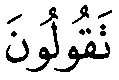
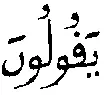
taquluna
you (plural) say, Q2:140
yaquluna
they say, Q2:139
There are different letters at the beginning of these words.
This difference changes the meaning from "you" to "they".
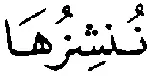
nunshizuhaa
we shall raise up, Q2:259
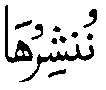
nunshiruhaa
we shall revive/make alive, Q2:258
There are different root letters in these words and this makes two
different words. The two words have a similar meaning but are not identical.
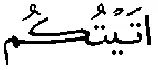
ataytukum
I gave you, Q3:81
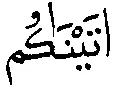
ataynakum
We gave you, Q3:80
There are different letters in the middle of these words.
This difference changes the meaning from "I" to "we".
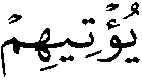
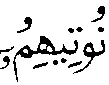
yu'tiihim
he gives them, Q4:152
nuutiihimuu
we give them, Q4:151
There are different letters at the beginning of these words.
This difference changes the meaning from "we" to "he".
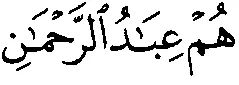
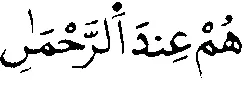
hum `ibadu l-rahmani
they are slaves of the Most Gracious, Q43:19
hum `inda l-rahmani
they are with the Most Gracious, Q43:19
The middle letter of the middle word is different in these verses. This changes the meaning
of these words significantly: In the Hafs qira'a the word is a noun and means slaves
while in the Warsh qira'a the word is a preposition and means with. Thus, the verses
have a different meaning.
VOWEL DIFFERENCES
Arabic uses small symbols (tashkil) above and below the letters
to indicate some of the vowels of a word. Here we see another difference
between these two Qur'ans; they do not use the same vowels in the same place.
THE QUR'AN ACCORDING TO THE QIRA'A OF IMAM HAFS
THE QUR'AN ACCORDING TO THE QIRA'A OF IMAM WARSH
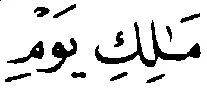
maaliki yawmi
Owner of the Day, Q1:4
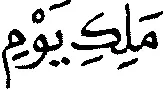
maliki yawmi
King of the Day, Q1:3
The Hafs qira'a has a long alif which makes an active participle
meaning owner, while the Warsh qira'a is a nominal noun meaning king.
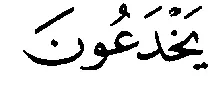
yakhda'uuna
they deceive, Q2:9
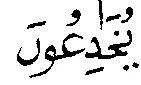
yukhaadi'uuna
they seek to deceive, Q2:8
There are different vowels on the first and second letters of these words.
The Hafs qira'a is a 1st form of the verb, while the Warsh qira'a is a 3rd form.
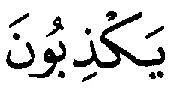
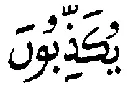
yakdhibuuna
they lie, Q2:10
yukadhdhibuuna
they were lied to (or) they deny, Q2:9
There are different vowels on the first and second letters of these words.
The Hafs qira'a is a 1st form of the verb, while the Warsh qira'a is a
2nd form either active or passive. (Note: this word appears twice in this verse.)
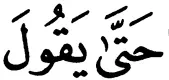
hatta yaquula
so that they said, Q2:214
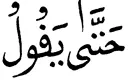
hatta yaquulu
until they said, Q2:212
There is a different vowel on the last letter.
The fatha vowel used in the Hafs qira'a places the verb into the subjunctive mood
which gives the preceding particle hatta the meaning so that.
The Warsh qira'a uses the damma vowel which places the verb into the
imperfect indicative mood which gives the particle hatta the meaning until.
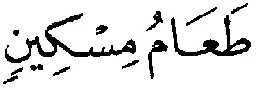
ta'aamu miskiinin
a redemption by feeding a poor man, Q2:184
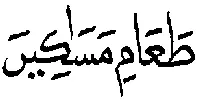
ta'aami masakiina
a redemption by feeding poor men, Q2:183
There are several different vowels in these words.
These change the noun from singular to plural; and hence changes the number of men
you are required to feed to redeem yourself for failing to fast.
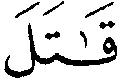
qatala
And many a prophet fought, Q3:146
qutila
And many a prophet was killed, Q3:146.
There are different vowels in these words.
These change the meaning from the active to the passive and thus changes the meaning of the verse.
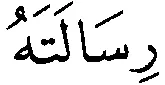
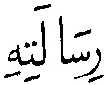
risaalatahu
his message, Q5:67
risaalatihi
his message, Q5:69
There are different vowels on the last two letters of these words.
These change the case and pronunciation of the word. The Hafs qira'a is in
the accusative case while the Warsh is in the genitive. This reflects a
different understanding of the grammar of the sentence.
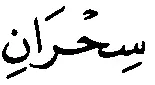
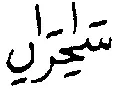
sihraani
two works of magic, Q28:48
saahiraani
two magicians, Q28:48
There are different vowels on the first two letters of these words.
These change the word from an active participle in the Hafs qira'a to a noun in the Warsh
and thus changes the meaning of the verse.
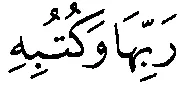
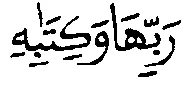
rabbiha wa kutubihi
her lord and his books, Q66:12
rabbiha wa kitabihi
her lord and his book, Q66:12
There are different vowels used for the word kitab (book).
This difference makes the word plural in the Hafs qira'a and singular in the Warsh qira'a.
This slightly changes the meaning of the verse because in the Hafs qira'a Mary believes in all
of God's books, while in the Warsh qira'a she believes in the book that is with her.
THE NUMBER OF DIFFERENCES
We have now considered four types of differences between these two
Qur'ans: extra words, differences in letters, diacritical dots and vowels, but how many of these
differences are there between these two Qur'ans? There are Islamic reference books
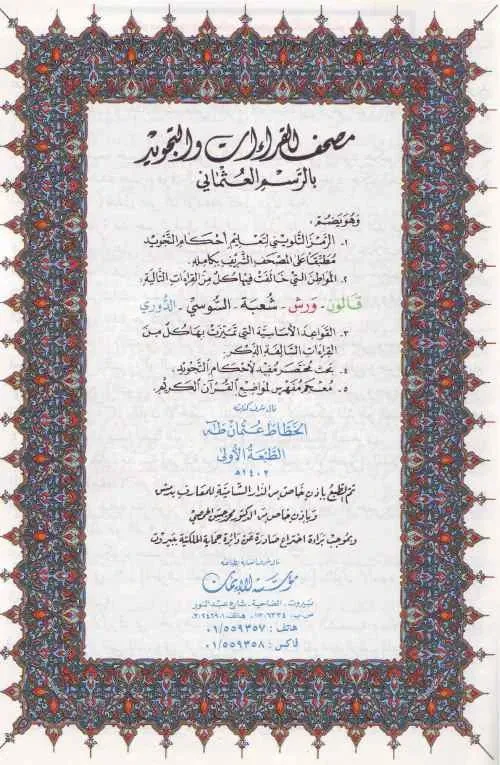
that answer this question. The title page below is from a book entitled,
"The Readings and Rhythm of the Uthman (Qur'anic) Manuscript".
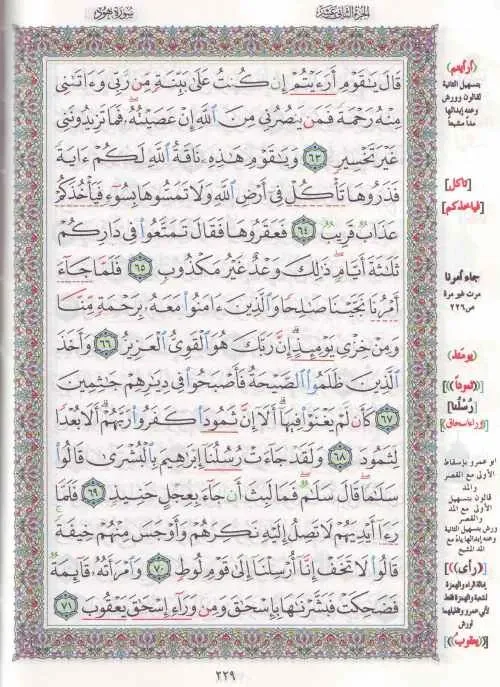
In this book the author displays the text of the Hafs Qur'an but
underlines any word where there is a difference among the readers.
This difference is then shown in the margin. The author has used
a colour coded system to show which reader is different. If the variant word
in the margin is red this indicates that the reader was Imam Warsh.
Please study the page below and identify the underlined
words and then the corresponding colour coded words
in the margin.
When the red coded differences are counted there are found to be
1354 accepted differences between the Hafs and Warsh Qur'ans.
BASMALAH DIFFERENCES
There is another type of difference between these two Qur'ans, the Basmalah.
The Basmalah is the phrase, "In the Name of Allaah, the Ever-Merciful, the Bestower of Mercy".
Both the Hafs and Warsh Qur'ans have the Basmalah at the start
of every surah except surah 9. However, while both these Qur'ans have the Basmala, it is understood in very different ways.
For Imam Hafs, the Basmalah was part of the revelation and the first verse of each surah, while for Imam
Warsh, the Basmalah was not the first verse but added like the surah titles.
Abu Ammaar Yasir Qadhi explains this.
The basmalah is the phrase that occurs at the beginning of each soorah
of the Qur'aan, except for Soorah at-Tawbah, and reads, as every Muslim knows,
'Bismillaah ar-Rahmaan ar-Raheem'
(In the Name of Allaah, the Ever-Merciful, the Bestower of Mercy).
There is a difference of opinion amongst the scholars of the Qur'aan over whether
this phrase is to be considered as a verse at the beginning of each soorah, in
particular Soorah al-Faatihah, or whether this is merely a phrase said for
blessings between the soorahs, and is meant to identify where one soorah
ends and the next begins.
The scholars are agreed that the basmalah does not form part of Soorah
at-Tawbah, and that it is a verse of the Qur'an in 27:30 [...] but disagree as to its
status at the beginning of the other soorahs [...]
The scholars who claim that the basmalah at the beginning of the soorahs
is a verse of the Qur'aan, (include) Imaam ash-Shaafi'ee (d. 204 A.H.) (and) Imaam Ahmad (d. 241)
[...]
However, those that do not hold the basmalah at the beginning of the soorahs
to be a part of the Qur'aan (include) Imaam Maalik (d. 179) (and) Aboo Haneefah (d. 150 A.H.) [...]
Based on this classic difference of opinion, the qira'aat (the Readers) themselves
differ over whether the basmalah was a verse in Soorah al-Faatihah and the other
soorahs. Among the Qaarees (the Readers), Ibn Katheer,'Aasim and al-Kisaa'ee
were the only ones who considered it to be a verse at the beginning of each soorah,
whereas the others did not.
(Abu Ammaar Yasir Qadhi, An Introduction to the Sciences
of the Qur'aan, pp. 157-158.)
This is significant for three reasons: first, there is no consensus as to where each surah begins. Second, Islamic scholars do not agree on what words are actually part of the Qur'an. Third, the Basmalah appears 113 times at the start of the surahs and has 4 words, which means there are 452 extra words in the Qur'an according to Imam Hafs than the Qur'an of according to Imam Warsh.
THE EXTENT TO WHICH THE DIFFERENCES AFFECT THE MEANING
I am often told by Muslims that the differences between these
Qur'ans are only a matter of dialect, accent or pronunciation,
and do not affect the meaning, however,
this is not the case. The examples
given earlier show that the differences are more
significant: they change the subject
of the sentence, whether the verb is active or passive, singular or plural,
how the grammar of the sentence is to be understood, and whether or not
the Basmalah is even part of the revelation at the start of each sura.
These are differences in meaning not dialect.
Subhii al-Saalih[1] summarizes the differences into seven categories.
Differences in grammatical indicator (i`raab).
Differences in consonants.
Differences in nouns as to whether they are singular, dual,
plural, masculine or feminine.
Differences in which there is a substitution of one word
for another.
Differences due to reversal of word order in expressions where
the reversal is meaningful in the Arabic language in general or in
the structure of the expression in particular.
Differences due to some small addition or deletion in accordance with
the custom of the Arabs.
Differences due to dialectical peculiarities.
Therefore, the claim that these differences are just a matter of
dialect and do not affect the meaning is false.
COMPARING MORE ARABIC QUR'ANS
Our investigation so far has only considered two different Qur'ans,
but as we saw at the beginning of this article there are many others
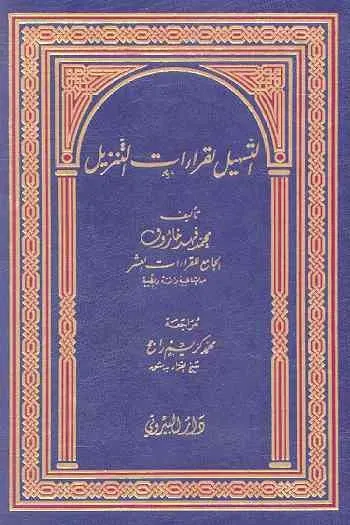
that could also be examined. The book below does this.
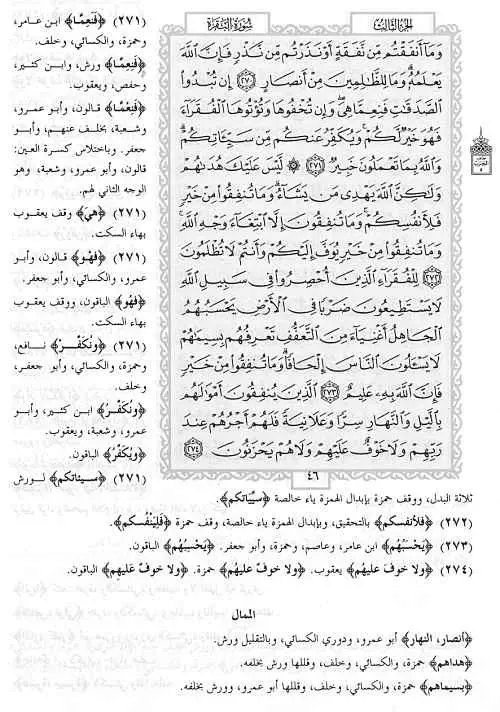
It is a Qur'an that lists the variants from the ten accepted readers.
Translation
Making Easy the Readings of What Has Been Sent Down
Author
Muhammad Fahd Khaaruun
The Collector of the 10 Readings
From al-Shaatebeiah and al-Dorraah and al-Taiabah
Revised by
Muhammad Kareem Ragheh
The Chief Reader of Damascus
Daar al-Beirut
In this edition of the Qur'an, Muhammad Fahd Khaaruun has collected the
variants from among the ten accepted readers and included
them in the margin of the 1924 Egyptian edition of the
Hafs Qur'an.
These are not all the variants, just the variants of
the ten accepted readers. As the title of his
book suggests this makes it easy to know what the variant readings are
because they are clearly listed. Below is a page from this reference Qur'an. You can see the variant readings listed in the margin. There are approximately 3000 variants.
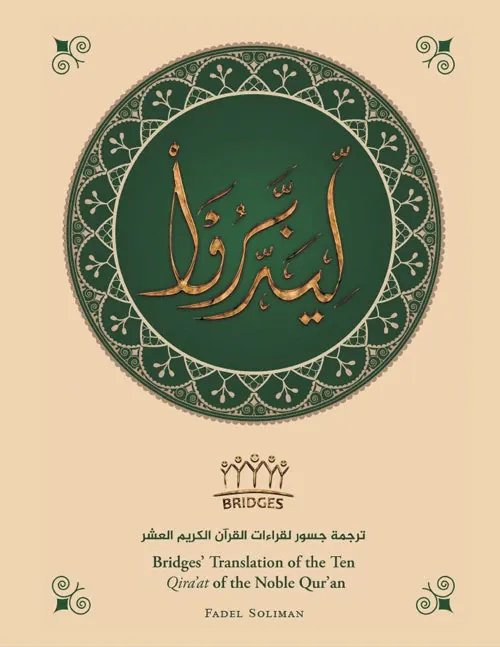
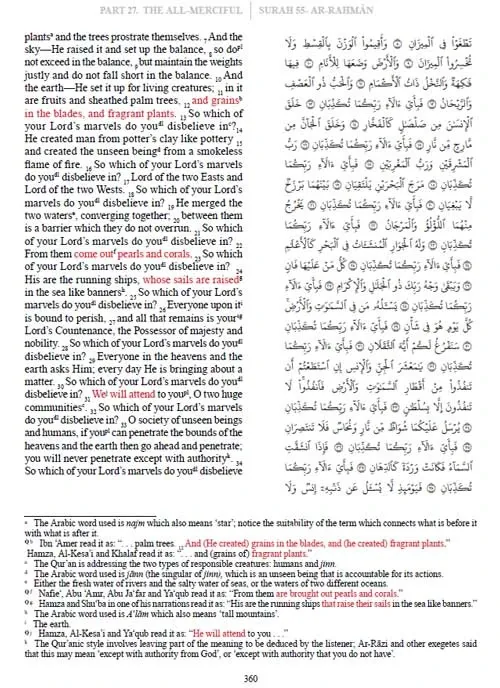
There is now available an English translation of the Qur'an which includes a translation of approximately 30% of the variants between the ten accepted qira'at. Here is the cover and a
sample page. The variants are displayed in red with alternative readings in the footnotes.
When these are counted there is found to be 965 variants.
To purchase this Qur'an see Appendix 9.
There are more variants than those of the ten accepted qira'at.
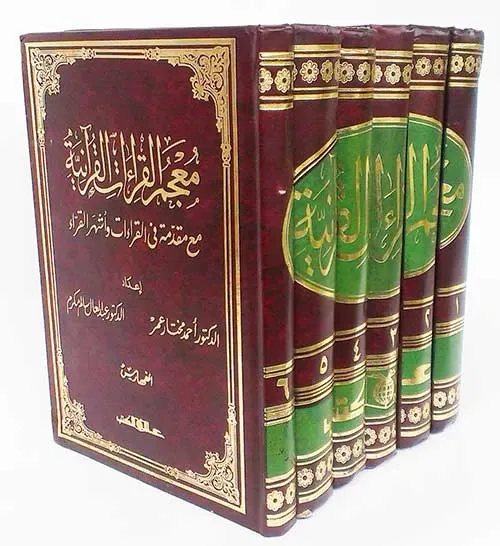
Below is a six volume encyclopedia set which records most of the known variants.
It is entitled: Mu'jam al-qiraa'aat al-Quraaneeyah, ma'a maqaddimah fee
qiraa'aat wa ashhar al-qurraa (The Encyclopedia of the Quranic
Readings with an Introduction to Readings and Famous Readers).
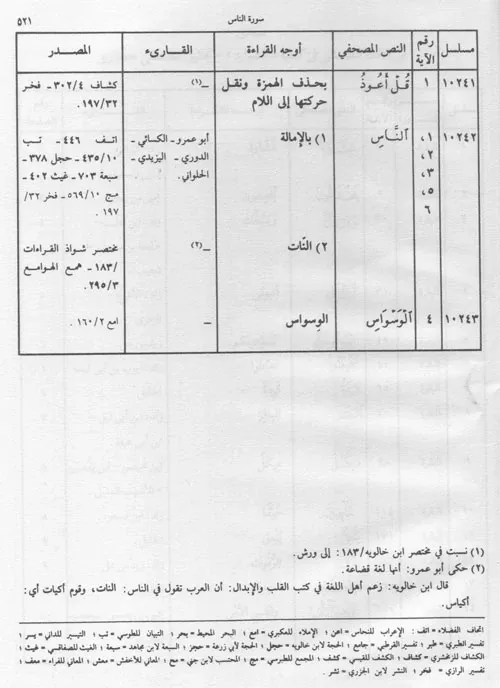
The page below is from this encyclopedia and shows the variants for the last sura of the Qur'an. The column on the right tallies the total number of variants listed for all suras. It states 10243 variants.[2]
CONCLUSION.
We began this article by considering this common
Islamic claim:
No other book in the world can match the Qur'an [...]
The astonishing fact about this book of ALLAH is
that it has remained unchanged, even to a dot,
over the last fourteen hundred years. [...] No
variation of text can be found in it. You can
check this for yourself by listening to the
recitation of Muslims from different parts of
the world.
(Basic Principles of Islam, p. 4)
This claim is wrong. All of the Islamic evidence shows there are different
Qur'ans used around the world today.
They differ in their words, basic letters,
diacritical dots, vowels, and the Basmalah; and these change the meaning of words and sentences, and the number of words in the Qur'an. Not all Qur'ans are identical.
Islamic leaders should stop exaggerating about the Qur'an.
If you are a Muslim, please do not believe or make these claims. If
you are a Christian, do not believe these exaggerated claims.
This article only considers the different Qur'ans used in the world today. If you wish to learn about the different Qur'ans in Islam's early history then
read The Preservation of the Qur'an.
APPENDIX 1 - HOW DO ISLAMIC SCHOLARS UNDERSTAND THE DIFFERENT QIRA'AT?
The traditional Islamic view is that all of the authentic qira'at are
from God, and the differences between them are to be harmonized.
This oral tradition (of the Qur'an) embraces ten distinct systems of recitation,
or, as they are generally called among scholars, "Readings" (qiraa'aat), each
tranmitted by a "school" of Koran-readers deriving its authority from a prominent
reader of the second or early third century of the Islamic era. The slight variation
among the Ten Readings is attributable to the dialectal variation in the original
Revelation. [...] It should be emphasized that all of the Readings were transmitted
orally from the Prophet.
(Labib as-Said, The Recited Koran: A History of the
First Recorded Version, p. 53)
Every reading in accordance with Arabic (grammar) even if (only) in some
way, and in accordance with one of the masaahif of Uthmaan, even if
(only) probable, and with sound chain of transmission, is a correct (Sahiih)
reading, which must not be rejected, and may not be denied, but it belongs to
the seven modes (ahruf) according to which the Qur'aan was revealed, and
the people are obliged to accept it, no matter whether it is from the seven
Imaans, or the ten or from other accepted Imaans
(Abu-l-Khair
bin al-Jazari; cited from Ahmad von Denffer, Ulum Al-Qur'an, p. 119.)
However, not all Islamic scholars hold this view. Some consider it unreasonable to think that the Qur'an can be recited ten different ways. They believe there is only one recitation of the Qur'an because the word Qur'an means recitation, and that the different qira'at come from the readers and not God.
The Koran was originally recited in one
language and one dialect, namely that of the Quraysh.
However, as soon as readers from the different tribes
began to recite it, a variety of readings emerged, reflecting
dialectal differences among the readers. The diversity
was so great that later generations of readers and scholars
had to labor intensely over the recording and careful analysis
of these readings. In so doing they give rise to a special
science, or rather special sciences, devoted exclusively
to this enterprise. [...]
I should pause here to note that certain religious
authorities have supposed that the Seven Readings were
transmitted by a process of continuous transmission
(tawaatur) on a wide scale from the Prophet himself,
unto whom, so they allege, they were revealed by Gabriel.
These authorities therefore consider that whoever rejects
any of the established readings is an unbeliever. They have
not, however, been able to produce any evidence for what
they claim except that the tradition which reads, "The
Koran was revealed in seven dialects (ahruf)".
The truth of the matter is that the seven Readings had
nothing to do with the Revelation, nothing in the least;
and whoever rejects any of them is not for having done so
an unbeliever; nor has he sinned or gone astray in his religion.
The origin of these Readings is to be found in the diversity
of tribal dialects among the early Muslim Arabs, and everyone
has the right to dispute them, and to accept and reject them,
or parts of them, as seems proper.
In point of fact, people have disputed the Readings and
argued over them, and have even accused each other of
error with respect to them; yet we know of no Muslim who
ever charged another with unbelief over this matter.
(Taahaa Husayn,
Fi'l-Adab al-jaahilii, cited from Labib
as-Said, The Recited Koran: A History of the First Recorded
Version, pp. 97&99)
It is generally known that there are seven or ten different recitations
of the Qur'an - By recitation is meant the different wordings which convey
the same or allied meanings Maalik and Malik - Such as
Yatta'harna and Yat'harna. It is generally believed
the recitation of the seven or the ten reciters of the first, second and third
century of Islam are valid and the Muslims are allowed to adopt either of
these in their reciting Qur'an and it is generally held that the origin of
these various recitations go back to the time of the Holy Prophet who approved
these varieties but according to the Shia Ithna-Ashari School whose views are
based on the teachings of the Holy Imams, the revealed recitation of the
Qur'an cannot be but one and as the Imam puts it, "Qur'an is One, came down
from the One, the variation in recitation comes from the reciters not from God."
(S. V. Mir Ahmed Ali, The Holy Qur'an: Text, Translation and Commentary, p. 58a)
APPENDIX 2 - ARE THE QIRA'AT DIFFERNT VERSIONS?
Is it correct to call the different qira'at, "different versions". Yes, because the different qira'at are precisely what is meant by the word version.
The Oxford Languages online dictionary defines 'version' as, "a particular form of something differing in certain respects from an earlier form or other forms of the same type of thing." This is precisely what Muslim leaders claim about the qira'at. They maintain there is one thing called the Qur'an and the qira'at are different forms of it. This is what the word version means.
APPENDIX 3 - ARE THE QIRA'AT DIFFERENT QUR'ANS?
Is it correct to call the qira'at, "different Qur'ans". Yes, because the word, Qur'an, means recitation, and each of the ten qira'at is a different recitation. There is not one recitation but ten, therefore, there is not one Qur'an but ten.
APPENDIX 4 - THE QUR'AN IS ORAL NOT WRITTEN
Some Muslims have told me
that it doesn't matter if there are differences between the written Qur'ans
because the Qur'an is firstly oral and only secondarily written.
However, this is a false distinction for two reasons: firstly, the Qur'an
says that it is written (Qur'an 80:11-15) just as it is memorised.
Secondly, these written Qur'ans are meant to be an exact
record of the oral recitation of the ten famous readers.
Thus the differences between the written Qur'ans
are the differences between the oral recitations.
APPENDIX 5 - THE ORIGIN OF THE TEN QIRA'AT - THE COMMON TRADITIONAL EXPLANATION
Why are there ten qira'at and not one? The common traditional Islamic answer comes from a hadith.
1. There is a hadith in which Muhammad said Allah gave the Qur'an in seven different ways (Arabic: ahruf).
Narrated Umar bin Al-Khattab: [...] [Muhammad said] "This Qur'an has been revealed
to be recited in seven different ways [ahruf], so recite of it whichever is easier for you." (Sahih al-Bukhari 4992; vol 6, bk 61, no 514)
2. These differences caused problems for the early Muslims.
Narrated Anas bin Malik: Hudhaifa bin Al-Yaman came to Uthman at the time
when the people [Muslims] of Syria and the people of Iraq were waging war
to conquer Armenia and Azarbaijan.
Hudhaifa was afraid of their [the Muslims from Syria and Iraq] differences
in the recitation of the Qur'an, so he said to 'Uthman, "O chief of
the Believers! Save this nation before they differ about the Book (Quran)". (Sahih al-Bukhari 4987; vol 6, bk 61, no 510)
3. Caliph Uthman solved this problem by establishing one text
and destroying the other Qur'ans. His goal was to remove the
differences and unite the Muslim community around a single text recited
in the Qurayshi dialect.
So 'Uthman sent a message to Hafsa saying, "Send us the manuscripts of the Qur'an
so that we may compile the Qur'anic materials in perfect copies and return the
manuscripts to you." Hafsa sent it to 'Uthman. 'Uthman then ordered Zaid bin
Thabit, 'Abdullah bin Az-Zubair, Said bin Al-As and 'AbdurRahman bin Harith
bin Hisham to rewrite the manuscripts in perfect copies.
'Uthman said to the three Quraishi men, "In case you disagree with
Zaid bin Thabit on any point in the Qur'an, then write it in the dialect
of Quraish, the Qur'an was revealed in their tongue."
They did so, and when they had written many copies,
'Uthman returned the original manuscripts to Hafsa.
'Uthman sent to every Muslim province one copy of what they had copied,
and ordered that all the other Qur'anic materials, whether written in
fragmentary manuscripts or whole copies, be burnt. (Sahih al-Bukhari 4987; vol 6, bk 61, no 510)
4. Uthman's Qur'an removed most of the differences, however, some were able to remain due to the ambiguous nature of the Arabic script that was used at this time.
The [Arabic] script used in the seventh century, i.e. during the lifetime of the
Prophet Muhammad, consisted of very basic symbols, which expressed only the
consonantal structure of a word, and even that with much ambiguity. While today
letters such as baa, taa, thaa, yaa, are easily distinguished by points, this was
not so in the early days and all these letters used to be written with a straight
line.
(Von Denffer, `Ulum Al-Qur'an - An Introduction to the Sciences of the Qur'an, 1994, p. 57)
The ambiguous nature of the script of Uthman's Qur'an allowed some qira'at/readings from the other ahruf to be transferred into Uthman's Qur'an.
If a qira'at/reading from another ahruf was compatible with Uthman's text,
it could continue to be recited in Uthman's Qur'an. In this case the dots and vowels were in different places on the one script.
This resulted in different qira'at/readings being recited for the same word in Uthman's Qur'an. Thus, the reciting of the Qur'an was now a mixture of different ahruf that were compatiable with the Uthmanic text.
5. Without the dots to distinguish letters or the vowel markings, the Uthmanic Qur'an
was ambiguous to Muslims whether they were Arab or not. This allowed new variants to
arise as people interpreted the ambiguous text.
When more and more Muslims of non-Arab origin and also many ignorant Arabs studied
the Qur'an, faulty pronunciation and wrong readings began to increase. It is related
that at the time of Du'ali (d. 69H/638) someone in Basra read the following aya from the Qur'an in a faulty way, which changed the meaning completely:
That God and his apostle dissolve obligations with the pagans (9:3)
That God dissolves obligations with the pagans and the apostle.
This mistake occurred through wrongly reading rasulihi in place of rasuluhu,
which could not be distinguished from the written text, because there were no signs or accents
indicating the correct pronunciation. Unless someone had memorised the correct version
he could out of ignorance easily commit such a mistake.
(Von Denffer, `Ulum Al-Qur'an -
An Introduction to the Sciences of the Qur'an, 1994, p. 58)
Islamic scholars record that at least 50 different qira'a/reading systems developed for Uthman's Qur'an.[3] These different qira'at show that a range of opinions existed as to how the Uthmanic text could be interpreted and read, and that there was some confusion about this. The Uthmanic text gave the Qur'an macrostability, but its ambiguous script led to microfluidity.
6. In the 4th Islamic century, Ahmad ibn Musa ibn Mujahid solved this problem by choosing seven of the qira'at as canonical, and in time another three were added.
Reciting any of the non-canonical qira'at was now forbidden and punishable.
Two Qur'an readers were famously tried for reciting unacceptable variants, Ibn Miqsam in 322/934 and
Ibn Shannabudh in 323/935. Both were forced to recant.
(Christopher Melchert, Ibn Mujahid and the Establishment of the Seven Qur'anic Readings, p. 5)
This is the common traditional explanation for how the seven ahruf became the ten qira'at.
There are four problems with this common traditional explanation about the seven ahruf and ten qira'at. Firstly, Islamic scholars do not know what the seven ahruf are.
As for what is meant by these seven ahruf, there is a great deal of difference on this issue. Ibn Qutaybah (d. 276 A.H.) recorded thirty-five opinions on the issue, and as-Suyootee listed over forty. Ibn Sa'adan (d. 231 A.H.), a famous grammarian and reciter of the Qur'aan, even declared that the true meaning of the ahruf was known only to Allaah, and thus to
attempt to investigate into this issue was futile!
(Abu Ammaar Yasir Qadhi, An Introduction to the Sciences of the Qur'aan, p. 175)
How can we say that the ten qira'at come only from the seven ahruf if we do not know what the ahruf are?
Secondly, there are ten qira'at not seven, and Muhammad is supposed to have allowed seven not ten different ways.
Thirdly, if Muhammad did allow the Qur'an to be recited in seven different ways, then his closest companions would have continued Muhammad's sunna/practice. Instead, Uthman does the opposite. He standardises one text in the Qurayshi dialect and tries to remove all the other ways.
Fourthly, the Qur'an never says it can be recited in seven or ten different ways. It only speaks of itself as one.
For these reasons the common traditional explanation does not seem authentic. However, there is an alternative traditional explanation which is outlined in the next appendix.
APPENDIX 6 - THE ORIGIN OF TEN QIRA'AT - AN ALTERNATIVE TRADITIONAL EXPLANATION
The alternative explanation does not begin with the hadith about the seven ahruf, but with the Qur'an. The Qur'an says that some parts of it were forgotten, but this was Allah's will.
We will make you recite, [O Muhammad], and you will not forget,
except what Allah should will. (Qur'an 87:6-7)
We do not abrogate a verse or cause it to be forgotten except that We
bring forth [one] better than it or similar to it. (Qur'an 2:106)
This is also taught in the Hadith.
Narrated Aisha: The Prophet heard a man reciting the Qur'an in the mosque and
said, "May Allah bestow His Mercy on him, as he has reminded me of such-and-such
verses of such a Surah." (Sahih al-Bukhari 5037; vol 6, bk 61, no 556)
'A'isha reported that the Apostle of Allah (may peace be upon him) listened
to the recitation of the Qur'an by a man in the mosque. Thereupon he said:
May Allah have mercy upon him; be reminded me of the verse which I had
been made to forget.
(Sahih Muslim 788b; bk 4, 1721)
Narrated Abdullah ibn Mas'ud: [...] [Muhammad said] I am only a human being and I forget
just as you do; so when I forget, remind me. (Sahih al-Bukhari 401; vol 1, bk 8, no 394)
The effect of Muslims forgetting parts of the Qur'an is that the Qur'an was recited differently. This is seen in the following hadiths.
Abu Harb b. Abu al-Aswad reported on the authority of his father that Abu
Musa al-Ash'ari sent for the reciters of Basra. They came to him and
they were three hundred in number. They recited the Qur'an and he
said: You are the best among the inhabitants of Basra, for you
are the reciters among them. So continue to recite it. (But bear in mind)
that your reciting for a long time may not harden your hearts as
were hardened the hearts of those before you. We used to recite a
surah which resembled in length and severity to (Surah 9) Bara'at.
I have, however, forgotten it with the exception of this which I
remember out of it: "If there were two valleys full of riches,
for the son of Adam, he would long for a third valley, and nothing
would fill the stomach of the son of Adam but dust." And we used
to recite a surah which resembled one of the surahs of Musabbihat,
and I have forgotten it, but remember (this much) out of it:
"Oh people who believe, why do you say that which you do not
practise" (Q61:2) and "that is recorded in your necks as a
witness (against you) and you would be asked about it on the
Day of Resurrection" (Q17:13). (Sahih Muslim 1050; bk 5, no 2286)
Ibn Abbas reported [... Umar said] Allah sent Muhammad (saw) with the Truth and revealed the Holy Book to him, and among what Allah revealed, was the verse of the Rajam (stoning for adultery) and we did recite this verse and understood and memorized it. Allah's Apostle did carry out the punishment of stoning and so did we after him. I am afraid that after a long time has passed, somebody will say, "By Allah, we do not find the verse of the Rajam in Allah's Book", and thus they will go astray by leaving an obligation which Allah has revealed. [...] And then we used to recite among the Verses in Allah's Book: "O people! Do not claim to be the offspring of other than your fathers, as it is disbelief (unthankfulness) on your part that you claim to be the offspring of other than your real father." (Sahih al-Bukhari 6830; vol 8, bk 82, no 817)
Sahih Muslim 1050 shows that entire surahs have been forgotten after Muhammad's death. Sahih al-Bukhari 6830 shows two verses that had been forgotten. This led to the Qur'an being being recited differently after Muhammad's death. What does this have to do with the ten qira'at?
The types of differences between the qira'at are precisely the differences that happen when words in the Qur'an are forgotten, when there is a disruption of knowledge. When Uthman made his text for the Qur'an it did not have the dots to distinguish between letters, nor the vowel markings; it was an ambiguous text that served only as a guide. This is not a problem when the Qur'an is memorised because the correct letters and vowels are known from memory. But if some words are forgotten, then the ambiguous text for these words needs to be interpreted and the dots and vowel markings added as the interpreter/reader thinks correct. This is precisely what we see in the ten qira'at. The differences between them are where the ambiguous Uthmanic text has been interpreted differently and the dots and vowels placed in different places. This explanation of the ten qira'at comes from the Qur'an, Hadith, and from understanding the ambiguous nature of Uthman's Qur'an. It is a better explanation than the seven ahruf.
Therefore, the differences between the ten qira'at come from some words being forgotten and the readers having to interpret what the word may have been. Appendix 1 refers to scholars who hold to this explanation.
APPENDIX 7 - CHOOSING THE BEST QIRA'A - ISLAMIC SCHOLARSHIP IN PRACTICE
As we have seen in appendix 1, the traditional Islamic understanding is that all
of the authentic qira'at are from God. Now scholars can say these things but what they
do reveals what they truly believe.
This is the case for Abdullah Yusuf Ali who made one of the most famous and
widely used English translations of the Qur'an.
Yusuf Ali based his translation on the Hafs qira'a, however,
he consulted other qira'at, and sometimes used a different qira'a at certain points
in his translation. That is, he chose from among the qira'at the reading that
made the best sense.
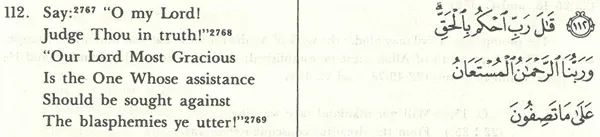
We see this with his translation and footnote for sura 21:112.
Below are scans from The Holy Qur'an: Text, Translation, and Commentary, 4th ed.,
Brentwood, Md., U.S.A.: Amana Corp., 1989, by Abdullah Yusuf Ali:
What has Yusuf Ali done in translating sura 21:112?
The Arabic text displayed in his translation is the Hafs version, and it reads
qaala (He said), however, Yusuf Ali has followed the majority
of the qira'at which read qul (Say).
The reason he gives for using a different qira'a is:
2767. [...] The beter (sic) reading is "Say" in the imperative, rather than
"He (the Prophet) said (or says)" in the indicative mood.
That is, he believes the Warsh qira'a, along with others, give a better
reading and so translates according to them.
He does this again for sura 21:4, and explains that his decision has the support
of other Islamic scholars:
2666. [...] But more than one Commentator
understands the meaning in the imperative, and I agree with them.
Choosing the best reading occurs throughout his translation. We see it again
for sura 23:112 with the choice explained in footnote 2948, and a highly significant choice
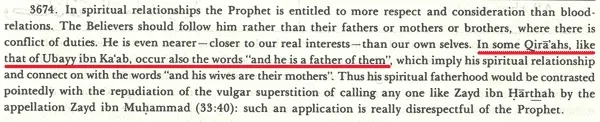
occurs in sura 33:6 with the following explanation:
Here we see that the reading/qira'a of Ubayy ibn Ka'ab has these extra words:
"and he is a father of them". This means Ubayy ibn Ka'ab recited sura 33:6 as follows:
The Prophet is closer to the Believers than their own selves, and he is a father of them
and his wives are their mothers. (Qur'an 33:6)
This difference has an enormous affect on the meaning: Should Muslims consider Muhammad
their father or not? In this case Yusuf Ali seems to accept both readings as valid but chooses
not to include Ubayy ibn Ka'ab's reading as part of his translation.
The Islamic scholar, Alan Jones, like Yusuf Ali, explains how he has
selected the best reading for his translation of the Qur'an.
The basic text used for this translation is that of the Egyptian standard edition,
first issued in 1342/1923 and revised in 1381/1960 and subsequently. This is the
most widely used text. It had it origins in the Iraqi city of Kufa in the second
century of the Islamic era, and is technically known as the Hafs recension
of the `Asim reading. Very rarely I have preferred a somewhat more conservative
reading that originated in Medina: Warsh's recension of Nafi's reading.
There is a note when I have done so. The notes also refer from time to time to the
readings of one of the Companions of the Prophet, `Abdallah Ibn Mas'ud.
(Alan Jones, The Qur'an - Translated into English, p. 19)
What these examples demonstrate is that Islamic scholars, in practice,
do not treat all of the qira'at/readings as equally valid but instead choose the best reading
from among them. It is not sensible to believe that God gave the Qur'an with thousands of variants;
and it is quite reasonable for Islamic scholars to choose the best reading from.
Christians do not have a problem with Islamic scholars doing this
because this is something Christian scholars do with variant readings in the Bible.
But Christians do have a problem when Muslims claim
that all the qira'at/readings are revelation when in practice Islamic scholars do not treat them
this way.
APPENDIX 8 - ARE THE ISNADS OF THE QIRA'AT RELIABLE?
As we saw in appendix 1, the traditional Muslim belief is that each
of the ten accepted qira'at, as a whole, can be traced
perfectly back to Muhammad. The isnad is the list of names of those
who it is believed passed this qira'a from Muhammad. Thus the claim is that the whole of the
Hafs Qur'an, in this form, can be traced back to Muhammad.
However, the relationship between the seven ahruf and ten qira'at makes the authenticity of these isnads problematic.
As we saw earlier, Uthman destroyed most of the
differences between the ahruf, and only those readings/qira'at that
were compatible with his basic text were able to remain. This means that the ten qira'at based on
Uthman's Qur'an are a mixture of qira'at from
various ahruf and not a continuous whole qira'a going back to Muhammad. It is this mixture that allows the seven to become ten.
If a Qur'an is a mixture of qira'at then it requires a separate isnad for each part of the mixture.
Yet the Hafs and Warsh Qur'ans do not identify the different ahruf in them and give them an individual isnad.
Instead, one isnad is given for the whole qira'at, which is not possible.
The isnads for the ten canonical Qur'ans cannot go back to Muhammad, instead, they can only go back to the ten readers who interpreted the Uthmanic text.
APPENDIX 9 - WHERE TO VIEW AND BUY DIFFERENT ARABIC QUR'ANS
Any Islamic bookshop should be able to order these Qur'ans for you. They are also available online
and from the following suppliers.
Qur'an Flash - Several versions of the Qur'an available for download.
ENDNOTES
[1] Subhii al-Saalih, Muhaahith fii `Ulum al-Qur'aan,
Beirut: Daar al-`Ilm li al-Malaayiin, 1967, pp. 109ff.
[2] Mu'jam al-qiraa'aat al-Quraaneeyah, ma'a maqaddimah fee qiraa'aat wa ashhar al-qurraa,
Prepared by Ahmad Omar and Abdelal Makram, Egypt, Cairo: Alam Al Kotob, third edition, vols. 1-6, 1997, vol. 5, p. 521.
[3] Al-Nadim, The Fihrist of al-Nadim - A Tenth Century survey of Muslim Culture,
New York: Columbia University Press, 1970, pp. 63-71. Also, Ibn al-JazarT, Nashr, vol. 1, pp. 34-7, cited from, Intisar A. Rabb, "Non-Canonical Readings of the Qur'an: Recognitition and Authenticity (the Himsi Reading)", Journal of Qur'anic Studies, 2006, vol. 8, no. 2, p. 124, footnote 114.
S. V. Mir Ahmed Ali, The Holy Qur'an: Text, Translation and Commentary,
New York: Tahrike Tarsile Qur'an, 1988.
Mu'jam al-qiraa'aat al-Quraaneeyah, ma'a maqaddimah fee qiraa'aat wa ashhar al-qurraa (The Encyclopedia of the Quranic
Readings with an Introduction to Readings and Famous Readers)
Prepared by Ahmad Omar and Abdelal Makram, Egypt, Cairo: Alam Al Kotob, third edition, vols. 1-6, 1997.
Basic Principles of Islam, (no author listed) Abu Dhabi, UAE: The Zayed
Bin Sultan Al Nahayan Charitable & Humanitarian Foundation, 1996.
Adrian Brockett, `The Value of the Hafs and Warsh transmissions for the Textual History of
the Qur'an', Approaches to the History of the Interpretation of the Qur'an, ed. Andrew
Rippin; Oxford: Clarendon Press, 1988, pp. 33-45.
Al-Nadim, The Fihrist of al-Nadim - A Tenth Century survey of Muslim Culture,
New York: Columbia University Press, 1970.
Intisar A. Rabb, "Non-Canonical Readings of the Qur'an: Recognitition and Authenticity
(the Himsi Reading)", Journal of Qur'anic Studies, 2006, vol. 8, no. 2, pp. 84-127
Subhii al-Saalih, Muhaahith fii `Ulum al-Qur'aan,
Beirut: Daar al-`Ilm li al-Malaayiin, 1967.
Labib as-Said, The Recited Koran: A History of the
First Recorded Version, translated by B. Weis, M. Rauf and M. Berger,
Princeton, New Jersey: The Darwin Press, 1975.
Abu Ammaar Yasir Qadhi, An Introduction to the Sciences
of the Qur'aan, United Kingdom: Al-Hidaayah, 1999.
In the following post I quoted from some early Christian sources showing how certain Christians believed that the antichrist would arise from Dan: Dan: The Tribe of Antichrist.
Here I will share the biblical verses, which would have led these Christian writers to conclude that Dan is the tribe of
Unless noted otherwise I will be citing the Authorized King James Version (AV) of the Holy Bible. The AV has the advantage of notifying the readers when the Hebrew, Aramaic and Greek languages, which the inspired Scriptures were written in, employ second person singular verbs, participles, adjectives and/or pronouns