After we published our response, MENJ quickly updated his article regarding Allah praying for Muhammad (*).
In this updated version, MENJ makes several points which we will address here. In relation to an alleged pre-Islamic poem invoking a blessing on wine, MENJ writes:
Noteworthy of this poetry is its usage in first
"invoking blessings upon" (wa sallâ ala) the jar, and at
the same time attempts to "sought assistance from God" with regard to the
contents of the jar, hence signifying that the usage of the verb sallâ certainly
does not mean "to pray upon" the subject as a deity. Rather, it is
clear from this usage of this particular pre-Islamic verse that the idea of "invoking
blessings [sallâ] upon" the subject is not an indication of direct worship,
as it is inconceivable that a person would "worship" the jar and seek assistance
from God, both at the same time! Thus from the above verse, it is enough to demolish
the claims of Shorrosh and Shamoun combined.
It is obvious that MENJ is attacking a straw man, since the argument of Shorrosh and myself wasn’t that praying upon someone implies that the one being prayed for is a deity, or that the person in question is being worshiped. Rather, what MENJ’s own poem proves is that the verb sallâ means that one is praying to or invoking a deity, the emphasis being on prayer and invocation. Thus, when the Quran speaks of Allah performing sallâ for or on Muhammad, this doesn’t mean that Muhammad is a deity. Rather, this shows that Allah does actually pray. MENJ’s example shows that the person prayed TO Allah when he prayed FOR the wine, showing once again that sallâ means prayer and/or invocation.
Now MENJ may claim that this is what Mikhail implied since he wrote:
But in the Quran Allah, who is absolute, prays TO HIMSELF
on the prophet. The Muslims accept that. They should not question Christ's
deity because of his prayer on the cross. More importantly, if Allah and his angels
in heaven are praying on the prophet, and on earth Muslims are praying on the prophet,
then Mohammed is the center of worship in heaven and on earth. This is also the
conclusion arrived at by some intellectual Muslims.
The daily Egyptian Newspaper, Alwafd, (September 9, 1992), recorded the following
question sent to Sheik Hassan Mamoun, one of the prominent clerics in Egypt:
What is your judgment concerning prayer on Mohammed, the messenger of Allah, doesn't
that mean worshipping him?
Muslims never mention the name of Mohammed without saying peace be upon him or
in Arabic Salla Allaho Alihe Wasalaam or Alihe Alsalaato Wasalaam which means
"Allah's prayer and salutation on him."
(Mikhail, Islam Muhammad and the Koran: A Documentary Analysis, first
edition; online source;
bold and underline emphasis ours)
Mr. Mikhail is careful to state that the implication of surah 33:56 is that Muhammad becomes the very object of worship, and proceeds to document this point by citing an Egyptian newspaper where a questioner basically came to the same conclusion. Mikhail went on to provide additional documentation for this claim:
Look at any Islamic inscribed sign, and you will read
the name "Allah" at the same level of the name "Mohammed."
Muhmoud Al-Saadani, the well known Egyptian journalist,
wrote a critical article in the August 9, 1996 issue of Almussawar, Egyptian weekly
magazine, in which he said:
On the memorial birthday of the Messenger [Mohammed] I
listened to the Friday message on an Arabic television. The speaker was a young
man… he said while shedding tears over the decline of Muslims in this
age... the only cause for the Muslims’ demise in this age is that they do
not glorify the master of creatures, Mohammed Ibn Abdullah, as they should glorify
this glorious Messenger, who is the beginning and the last of all
creation... the early Muslims used to glorify the Prophet to the point of
drinking his urine...
Thus, passages such as surah 33:56 can lead, and have led, many a Muslim to deify and worship Muhammad.
MENJ comments on my response to the poem of Antarah:
An amusing missionary objection to the above is
that all the kings of the earth were actually worshipping the Emperor
Anûshirwân literally, when it is clear that there is certainly no such indication by the
poet 'Antarah. On the contrary, it is obvious even from the translation of this poem that
the poet is invoking a glorification upon the Persian Emperor, rather than any
indication of any form of worship.
What is clear here is that MENJ ignored the data I gave to prove my point. The poet is commenting on the reverence shown to a pagan, Persian king and, as history attests, it was common amongst pagan circles to deify their ruler. Furthermore, MENJ has obviously not read the poem carefully since the poet isn’t invoking anything, but is commenting on what the kings were doing, i.e. they were all either worshiping him or facing his direction in their worship. As we noted, the king was also viewed as a religious priest.
Further evidence that the verb sallâ in this poem means prayer and/or worship can be seen from the poet’s claim that from all the places of the world the rulers were worshiping ("paying homage to") the Persian ruler, as did the people of the earth. It is quite obvious that the poet means that all these people were all worshiping in the direction of the Persian king from their own kingdoms and places, since the poet doesn’t say that they came to Persia in order to give homage there to the ruler. The poet clearly states that wherever they were, these individuals gave homage to him. Now how would they give the Persian ruler homage, seeing that he wasn’t in their very presence, if not by either worshiping him or facing his direction in their worship of the deity? In other words, the poem itself supplies enough clues to show that the verb sallâ here does refer to prayer, to worship.
Finally, MENJ assumes that translating sallâ as ‘paying homage’ alleviates his dilemma. This fails to take into account what I had said, that this rendering still leaves us with Allah and his angels all paying homage to Muhammad, compounding the problem. For instance, note the following dictionary meanings for homage:
Ceremonial acknowledgment by a vassal of allegiance to his lord under feudal law.
Special honor or respect shown or expressed publicly.
(Source)
The above poem refers to vassal kings paying homage to their conquering ruler, which means that the first definition applies here. Thus, even taking for granted the validity of this translation, MENJ is now left with Allah and the angels coming under Muhammad’s subjection which results in their paying homage to him, much like the vassal kings did in honor of the Persian conqueror! After all, he is trying hard to show that sallâ doesn’t necessarily mean to pray in order to deny the fact that Allah, according to the Quran, does pray. But the only way the above example can even establish MENJ’s position is if he is agreeing that sallâ in surah 33:56 carries the same meaning as it does in the poem. It is obvious that this is not what MENJ believes, which shows that his attempt of trying to prove that sallâ can also mean homage does absolutely nothing to refute the plain Quranic teaching that Allah literally prays since the contexts are not the same.
Note: Lest MENJ misrepresents our argument, and decides to attack a straw man again, we are not saying that sallâ means that if one prays for someone, then the person prayed for is a deity. Rather, we are trying to emphasize the point that all of MENJ’s examples conclusively prove that the verb sallâ means prayer. In the case of the above poem, it is not certain whether the Persian king was being worshiped, or whether the people were directing their worship to their god(s) by facing the direction of the king in honor of his position as their high priest and ruler. But in either case, the use of the verb even here clearly means prayer and/or worship, since acts of worship oftentimes involve prayers.
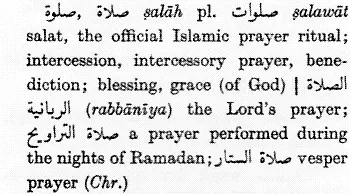
MENJ then appeals to Hans Wehr's Arabic dictionary in order to show that there is a difference in meaning between sallâ and salah.
In the case of the phrase
sallallâhû `alayhî wa sallam, it is understood as an eulogy of God
giving His Blessings upon someone[9].
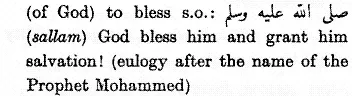
Hans Wehr's Dictionary of Modern Written Arabic defines sallâ
as thus:
[10]
... This is different from
salâh, ritual prayer or worship in the connotations that the Christian
missionaries intend it to be:
[12]
Would
the missionaries now accuse Hans Wehr of "embarrassment",
so much so that he translated sallallâhû `alayhî
wa sallam as "God bless him and grant him salvation!"?
Indeed, it is rather embarrassing for the missionaries to polemicise
such a trivial matter.
Should we only laugh about this argument or should we break out in laughter? That would be doing something entirely different, wouldn't it? Such is the quality of the argument presented above. It is up to the reader to decide where the embarrassment belongs after we are done with the discussion.
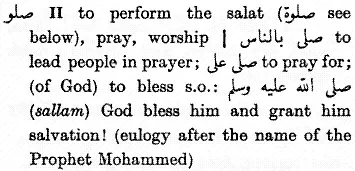
Why did MENJ display only the second half of the dictionary entry for sallâ? Was it because he thought the first part does not contain any information relevant to this discussion, or did he cut out that part because he tried to hide something from his readers? In any case, here is the entire entry for sallâ:
Thus, the Hans Wehr Dictionary clearly states that sallâ means "to perform the salat", "to pray", or "to worship", i.e. it means exactly what we have been saying that it means, and which MENJ has been trying to deny.
MENJ makes the claim that "Hans Wehr's Dictionary of Modern Written Arabic defines sallâ as thus: ... This is different from salâh, ..." as if these two words have very little to do with each other. Well, sallâ is as different from salâh as "to pray" is from "prayer" and "to strengthen" is from "strength" and "to laugh" is different from "laughter". The first, sallâ, is simply the verb (to pray) and the second, salâh, is the noun (prayer) derived from the same three consonantal root "S-l-w".
In particular, at the end of the third line of the entry for sallâ, Wehr gives the meaning of the expression salla ala as "to pray for" which is exactly the construction found in sallallâhû `alayhî wa sallam. If we were to replace the subject Allah with Ali then every Arab, whether Muslim or not, would translate that without hesitation as "Ali prays for him ...". It is simply the (so far unsubstantiated) claim of MENJ and many others that the exact same phrase means — and always meant — something different if a human subject is replaced with the name of Allah.
For argument's sake, let's assume that Wehr is right and "salla ala" generally means "to pray for"; only if God is the subject then it means "to bless someone". Why are most Muslim translations then not translating it accordingly? Most of them are similar to Yusuf Ali's rendering of S. 33:56, "Allah and His angels send blessings on the Prophet: O ye that believe! Send ye blessings on him, and salute him with all respect." They apparently feel uncomfortable to translate the very same word first as "to bless" and then as "to pray for" in the very same sentence. Therefore, they render both instances as blessing, even though Hans Wehr's dictionary does not allow "to bless" as meaning for "salla ala" when humans are the subject. If Hans Wehr is right, then most Muslim translations are wrong.
The case is further complicated by the fact that in the first part of the verse, there is only one verb for two subjects, Allah and His angels, i.e. Allah (the creator) blesses and the angels (created beings) pray for the prophet. I.e. the verb has to mean two things simultaneously. Somehow, it is hard to distribute the meaning as neatly as Wehr suggests.
MENJ thinks that Hans Wehr’s translation of the Arabic phrase proves his point that sallâ doesn’t mean that Allah prays. Instead of focusing on this dictionary MENJ should have busied himself with the meanings given by Muslim sources which we had cited, both in our original paper and in our response to him. MENJ needs to contend with Ibn Kathir, Qadi Iyad Musa al-Yahsubi, Ibn Al-Atheer, and Ibn Abbas who all said that the verb sallâ and other similarly related terms do mean prayer, with three of them even candidly admitting that Allah does actually pray.
To make sure that MENJ does not overlook the significance of those quotations, let's discuss one of them in some detail. Again, for argument's sake, assume that already in Muhammad's time salla can have both meanings, "to pray" and occasionally also "to bless". Then we still have to decide which meaning applies in any given instance; and that decision will have to be made based on the context. This is the statement of Ibn 'Abbas:
"The people of Israel said to Moses (peace be upon him): ‘Does your Lord
SALLA (yusallii)?’ His Lord (az wa gal) called him [saying]: O Moses, they
asked thee if your Lord SALLA (yusallii). Say [to them] ‘Yes, I do SALLA
(usallii), and my angels [salla] upon my prophets and my messengers’, and Allah
(az wa gal) then sent down on his messenger (prayer and peace be upon him): ‘Allah
and His angels SALLA (yusalluun)...’"
[quoted by Ibn Kathir on Surat
Al-Ahzaab 33:56; translated from the
Arabic online edition]
Obviously, Muhammad's contemporaries — and the Israelites before them — raised a difficult question. If the question should be translated "Does your Lord bless?" then there is no problem to be answered. There simply is no question. Yes, God blesses. He blesses many people. There are hundreds of passages in the Bible where God blesses. The calling of Abraham was for the very purpose of blessing him and blessing multitudes through him (Genesis 12:1-3). In fact, it is believed in basically all religions that God or the gods bless those who worship them properly. If "to bless" had been the meaning of the word, nobody would have raised the question in the first place. The very existence of the above passage only makes sense if the word salla is translated in its normal meaning, to pray. It would make sense to ask, "Does God bless people who do this or that?", or, "What do I need to do so that your Lord blesses me/us?", i.e. a specific restricted question. But the categorical question, "Does your Lord bless (at all)?", would be strange.
The very question introducing this quotation makes sense only if it is translated as "Does your Lord PRAY?" Interestingly, the answer is not, "No!", as one might have expected. The answer is YES, it it is affirmed that God prays, and surah 33:56 is revealed in response to this question. I.e. the historical context, the "occasion of the revelation", forces us to translate surah 33:56 as "Allah and his angels pray upon the prophet ..."
Moreover, already the title of Hans Wehr’ dictionary makes it clear that it is a dictionary for MODERN written Arabic and is therefore giving the meanings of Arabic words in common usage amongst Muslims TODAY (by today we mean in recent times). In other words, MENJ’s source is simply conveying the fact that the phrase sallallâhû `alayhî wa sallam is commonly translated by Muslims as "God bless him and grant him peace." We never denied that this is what Muslims claim the expression means.
How are dictionaries made? Lexicographers simply record the use of words. If sufficiently many people use a word incorrectly over a sufficiently long time, i.e. use it in a new meaning that it did not have before, it will become an established use and this new meaning will enter the dictionaries. The normal established meaning of salla, found in thousands of places, is to pray. That is the first and main meaning and is undisputed. For a considerable time now Muslims have claimed that there is one exception to the normal meaning of the word, i.e. if God is the subject, then this word means something else. Why? Because otherwise it would cause theological problems. If one claims the existence of another meaning long enough, and one simply uses and understands it differently long enough then this new understanding becomes established and the dictionaries will record it. However, this does not prove in any way that this is what it originally meant. That a word has a meaning today, doesn't imply that it had this meaning originally. It could well be a semantic anachronism, one of many etymological fallacies. Nevertheless, this dynamic explains what we observe in the dictionary entries on sallâ and salah.
Hans Wehr does give for the noun as one of the meanings "blessing", "benediction", although he gives no examples of its use. Similarly, Lane says whenever a human salla ala another human, it means to pray for him, but when God is the subject, it means to bless or magnify, although he gives no justification for this interpretation beyond the fact that this is what Muslims understand it to mean.
Our point was that this modern Muslim rendering seems to be not the literal meaning of the Arabic, but more of a paraphrase (if not a blatant distortion) signifying what they believe Allah is praying for, i.e. he is praying for blessing and peace upon Muhammad.
For example, Muslims bless Muhammad by praying for him, asking Allah to bless him and grant him peace. In a similar manner, Allah blesses Muhammad by praying for his peace and safety. Here, again, is surah 33:56 to help illustrate this point:
God and His angels send blessings on the Prophet: O ye that believe!
Send ye blessings on him, and salute him with all respect. Y. Ali
MENJ will have no problem admitting that the way angels and believers send their blessings on Muhammad is by praying to Allah and invoking him for blessings on their prophet. But this is where the problem lies. We know whom Muslims pray to when they pray for Muhammad’s peace and safety. But who does Allah pray to when he prays for Muhammad? He either prays to himself or to someone else. This is something which MENJ has yet to address. And to see why the above translation is not accurate since the text does not have the Arabic word for bless, please consult our first rebuttal for the details.
Finally, it is interesting to observe that MENJ is attacking and denouncing the translations of several authors, Anis Shorrosh, Labib Mikhail, Abdullah Al-Araby, besides our own, without ever presenting in his article a viable alternative, i.e. a translation that he considers to be the best or at least an appropriate and reasonably correct one, and why he thinks it to be correct. MENJ quotes the rendering found in Hans Wehr's dictionary, "God bless him and grant him salvation!", but leaves it open whether he only appreciates it because it contradicts our point, or whether he actually agrees with it. We doubt that this would be his translation of choice, since the request "God ... grant him salvation!" implies that the eternal salvation of Muhammad remains in question, or else why would millions upon millions of Muslims still have to put such a request for his salvation before God, and that several times on every day?
MENJ proceeds to attack more straw man arguments:
So far, the main crux of the Christian missionary
disparagement is that the verb sallâ is invoked upon the Prophet Muhammad,
upon whom be peace. The only reason that they are even raising the issue, if at all,
is because the Prophet sallallâhû `alayhî wa sallam is mentioned in God's
infinite Blessings. However, the missionaries are wrong to assume that only the Prophet
Muhammad(P)
is given this treatment as Muslims also apply this phrase to the Prophet Abraham(P) and his family in
their daily prayers.
After mentioning the Muslim prayer for Abraham’s family, MENJ continues to say:
Now the missionaries have a problem that they have
created for themselves. If it is true that the Prophet Muhammad(P) is the only
Prophet that God "worships" to, they then have to explain how does this
invocation which every Muslim recites in his prayers comes about and why the Prophet
Abraham is now mentioned in this prayer. For if we were to read the above prayer
according to their interpretation, we would hence notice that:
(a) The Prophet Abraham(P) and his
family is yet among the various people that God Almighty "prays to";
and;
(b) The whole prayer above does not make any logical sense, since the supplication is
directed at God and it also states that God is the Most Praise-worthy and the Most
Glorious.
Hence we can witness yet again the silliness of such a polemic which contravenes the
strict monotheism of Islam. For now God does not only "pray to" Muhammad(P) and his
family but He also indulges in the "worship" of Abraham(P) and his family!How[sic] hillarious
it is to see the missionaries digging a hole for themselves for which there is no way out.
Response:
In the first place, none of the persons in question (i.e., Shorrosh, Mikhail, Araby, and myself) said that Allah prays only for Muhammad. MENJ may have assumed that this is what Dr. Shorrosh was saying when he wrote:
… Or does Allah really pray to other human beings or only to Muhammad, Allah's own
prophet? …
Dr. Shorrosh doesn’t deny that Allah prays to others, but simply expressed that he was uncertain whether he does. Yet since MENJ claims to have read my article, he must have seen the following citations:
Upon them shall be prayers (salawatun) from their Lord and mercy, and
they are the rightly directed. S. 2:157
He it is who sends PRAYERS on you (Arabic- yusallii alaykum), as do His
angels … S. 33:43
These were the citations that I provided in my article to show that Allah prays for a lot of individuals, not just for Muhammad. It is therefore evident that MENJ is attacking a straw man at this point.
Second, even if assuming that the argument was that Allah prays to Muhammad, as opposed to praying for or upon him, citing an example where Allah also prays for/upon Abraham doesn’t resolve the matter. This would only prove that Allah doesn’t only pray to Muhammad, but he also prays to other people as well.
Third, it is not that Allah prays TO either Muhammad or Abraham and his family, but that he PRAYS for them. Again, the issue we are dealing with is the fact that Allah actually, literally prays. Since Allah prays for Muhammad, Abraham, their families, believers etc., the following question then arises: Who does Allah pray TO when he prays FOR these individuals? Does he pray to himself or to someone else? This is the real crux of the matter.
MENJ’s revised paper essentially ignored the great bulk of our response which established beyond a reasonable doubt that Allah does pray. And if MENJ has no problem with Allah praying, then he has no grounds to attack the Deity of the Lord Jesus Christ on the basis that he was praying to his Father.
I list here the pronouncement on the biblical canon from the council of Trent, taken from the following post: General Council of Trent: Fourth Session. All emphasis is mine.
Celebrated on the eighth day of the month of April, in the year MDXLVI.
DECREE CONCERNING THE CANONICAL SCRIPTURES
The sacred
God had promised the Israelites that the glory of the second temple would be greater than the first and that it would be there that he would give/establish peace:
“On the twenty-first of the seventh month, the word of Yahweh came by the hand of Haggai the prophet saying,