Zaman didn't take that critique very well and published
a reaction to it that
was, in my opinion, rather emotional and off-base.
The following is my reply to his claims
and accusations.
Suggestion to the reader: Make the interaction between Zaman's article
and my response below a test case for evaluating your own ability of critical thinking. Despite
my negative comment above, his article is actually a masterpiece of polemical rhetoric.
Before
you proceed with reading my answer, read Zaman's article first — without being influenced by my comments —
so that you can appreciate the full force of his arguments.
While you read ask yourself these
questions: Has Zaman made a good case? Is your main impression positive or negative? Why?
What elements or arguments in particular did you find convincing? Why? Is his case conclusive
or what is still lacking? What elements were distractive, insufficient, bad ... ? Why? Can you
find any arguments countering his claims? Write down your thoughts.
Actually, the best training
effect would probably be achieved by reading in this sequence:
(1) Zaman's article with
the above questions, (2) my original article that
he responded to, (3) Zaman's
article again, asking yourself now the additional question: Has he actually rebutted my
article? Which arguments did he respond to, which arguments did he ignore? How does this effect
your evaluation of his response?
(4) While reading my answer given in this paper, you should be fair and consistent and ask
the same questions listed above also about my article. Compare your evaluation with mine.
Which of my observations and arguments did you find on your own? Have you made different
or additional observations? What is your conclusion after you have read my response? Has my
answer changed your view of Zaman's article in any way? Let
me know whether this was a worthwhile exercise for you. In fact, to add a little incentive,
for every further error of fact or error of logic in Zaman's article that is not yet covered
in this rebuttal, the first one to report it will get a free Answering Islam CD. The same offer holds for those who find substantial
errors of fact or logic (i.e., not mere typos) in my response. [Let me know about typos as well,
please, but I can't afford to send out prizes for them.]
Looking at the length of my response some may wonder about the reason why I am dropping
something like an atomic bomb to kill a fly (i.e., why I am "using a sledgehammer to
crack a nut" to employ a proper English idiom) since Zaman's actual argument could
easily be refuted in just a page or two. To answer within the word picture: Zaman had
also a whole host of other bugs in his case and I wanted to get rid of all the pests
once and for all.
As you proceed you will come to understand the various related issues
I have taken up in my rebuttal. This article is mainly about recognizing and exposing
manipulative polemics, not just about answering an odd etymological argument.
Zaman's manifold errors together with his excessive bluster and silly diversions
have necessitated a rather long response, which I have structured in the following way:
Part I — On bluster, insults and fallacies
Preliminary comments and a discussion of Zaman's misunderstandings regarding ...
Trying to make sense of one missionary's venemous ad hominem satire
I will do my best to prove the above quotation from the Qur'an to be a false
prophecy. There will be no turning and fleeing.
Whether my arguments are indeed
strong and able to withstand the scrutiny of Muslim apologists, or whether they
are really no more than a trifling annoyance is a decision that I will
confidently leave to the judgment of the readers.
Answering Islam has
engaged Muslim propagandists for many years, and I do not recount ever having
been put to flight, although many have announced that they will utterly defeat,
humilate or even destroy us.
Because I am so fully convinced that Zaman is a highly intelligent man,
I am baffled all the more to find that Zaman apparently failed in his attempt
to understand my article.
Hardly as much as a trace of comprehending my main argument
is to be found in his response, although he clearly states in the subtitle that he was
trying to make sense of it.
Is it my inability to formulate clearly, his inability
to understand plain English language, or was uncontrolled anger darkening Zaman's
mind for ten whole days from the date of publication of my article to the date
(7/28/2003) when he published his response?
The comprehension problems start already in the title that Zaman chose for his response.
The etymological fallacy
In my original article I explained the nature
of an "etymological fallacy", gave plenty of examples for illustration, and then discussed
several instances of this fallacy as committed by Zaman in his publications.
Admittedly, the title of my article was chosen provocatively, although
appropriately in my view since I was responding to an argument that
was not only fallacious but a deliberate ridicule of the Christian faith.
His argument was bad, and I called him to account for it, expecting that
a man like Shibli Zaman who has been moving in the arena of Muslim-Christian
debating for nearly ten years and who does not spare his opponents with sharp
attacks and scathing rhetoric, should be able to receive as well as he gives
and be a good sport about it. Oh well, ...
I have discussed and given evidence for several actual etymolgocal fallacies
found in Zaman's publications. Thus, Zaman qualified to enter a competition
about who committed the worst such fallacy. I had a factual basis to pose this
question in the title of my article: Competing for the "Worst Etymological
Fallacy" Award?
Answering this question was left to the readers since it is preposterous
for a debator to declare himself the winner. In any debate, the decision
who made the better argument rests with the audience.
Zaman seemingly didn't feel comfortable to leave that decision to the readership
of my article and his response, so he usurped the position of the judge and
unilaterally decided to give the undesirable award to me.
I am sure not many
readers will appreciate being told what to think instead of being invited
to ponder the arguments and then decide themselves who made the more convincing
case.
However, in his rashness, and so desperately seeking to get rid of the trophy,
he overlooked that he cannot pass on the award to just anyone. Only those people
who have entered the competition can also win the award.
I searched in vain
through all of Zaman's article but I could not find even one place where he
showed that I committed an etymological fallacy.
The etymological fallacy is a clearly defined logical error, it is not
just any error made regarding the etymology of a word. I had stated that
the Greek word kuneo is not related to kuon, and in his response,
Zaman argues that I am wrong, and that kuon is indeed the etymon of
kuneo. If Zaman's response turns out to be correct, then
I committed an error of fact, but not an etymological fallacy.
Even after such a detailed discussion of the issue, Zaman has apparently still
not understood what an etymological fallacy actually is. This conclusion
is not only based on his formulation of the title but is finally proven by the way
he presents his main argument (cf. Zaman's use and abuse
of Strong's). Zaman certainly needs to go back to the drawing board on this one.
His choice of the title for his "rebuttal" was nonsense on
a factual level, lacking creativity from a rhetorical viewpoint, and otherwise
merely petty and vindictive; and his choice of the subtitle again confirms that
last point.
Which part of Zaman's response was correct and which of his claims are not true
will be discussed below. If I made a mistake in this article or in other articles
(despite my best efforts to speak and write only what I am convinced to be true),
then I will own up to it, apologize and correct my errors. I do not consider
myself infallible. My highest priority is knowing and speaking the truth,
not defending my pride.
Although it should already have been unambiguously clear after I had
discussed the etymological fallacy in several places in my paper on
Zaman's abuse of etymology,
and additionally given further examples in my response to Zaman's article
Talking Ants in the Qur'an?,
he has seemingly still not understood the issue.
Therefore, we have to revisit
the question: What is an etymological fallacy? In the following
I will supply several more quotations with definitions and examples, hoping that
one of these will eventually be understood. [Those who grasped the concept the first
time, are welcome to skip directly to the next point.]
ETYMOLOGICAL FALLACY
This is the name of a much-practiced folly that insists that what a word
"really means" is whatever it once meant long ago, perhaps even
in another language. A classic example is the argument that the adjective
dilapidated should be applied only to deteriorating structures made
of stone, because its ultimate source was the Latin lapis, meaning
"stone." Actually, the Latin dilapidare meant "to throw
away, to scatter, as if scattering stones," and the infinitive lapidare
meant "to throw stones." And in any case dilapidated no longer
has anything to do with stones in American English; today it means "broken
down, fallen into decay or disrepair," and it can be applied to any object,
garment, or structure, whatever it is made of. (Kenneth G. Wilson, The Columbia
Guide to Standard American English, Columbia University Press, 1993;
online source;
bold emphasis mine)
decimate (v.)
Today, decimate means "to destroy or kill or otherwise wipe out
a lot of any group or thing": Disease and hunger have decimated
the population of the Horn of Africa. When we first acquired thi
s
word from Latin, its meaning was "to execute one of every ten";
it was the way the Romans punished mutiny in the ranks. Some commentators
have insisted on that as the only allowable meaning, but in fact it has
long been obsolete, and the extended sense meaning "to take away or
destroy a tenth part of anything" is at least archaic and perhaps
obsolescent. Even if you use decimate intending it to mean "to
destroy one tenth," your audience will not understand it that way.
See ETYMOLOGICAL FALLACY.
(Op. cit.)
etymological fallacy. n. The mistaken notion that the true meaning
of a term lies in its primitive meaning (*etymology), that the earliest
historical occurrence of a term yields the correct definition. It is
a fallacy because the meanings of words evolve over time so that some
words are quite detached from their origins. Also called root fallacy.
See also illegitimate totality transfer. etymology. n. The study of the derivation of words, both their forms
and meanings. Also used of the product of such a study. See also etymological
fallacy. (Source: M. S. DeMoss, Pocket dictionary for the study of
New Testament Greek, InterVarsity Press: Downers Grove, Ill., 2001, p. 53)
The etymological fallacy occurs whenever someone falsely assumes that
the meaning of a word can be discovered from its etymology or origins.
Example: The word "vise" comes from the Latin "that which winds", so it means
anything that winds. Since a hurricane winds around its own eye, it is a vise.
(Fallacies
[Internet Encyclopedia of Philosophy]; bold emphasis mine)
Some philosophers have the vice (bad habit) to be complicated and use obscure
examples. I certainly did not know what a "vise" was when I found the above quotation.
A vise
is a "clamping device, usually consisting of two jaws closed or opened by a screw or lever,
used in carpentry or metalworking to hold a piece in position (The American Heritage® Dictionary
of the English Language).
The final and longer quotation about the false use of etymology is taken from
a language discussion forum:
It seems to me that in the past, the etymology of a word was erroneously
believed to have some bearing on its 'correct' usage. Perhaps this belief has
been stronger in the English-speaking world than elsewhere. Perhaps
we Anglo-Saxons are haunted by a word's history more than we should be.
When Samuel Johnson was compiling his Dictionary of the English Language
(1775), I believe he was often swayed by the history of a word when making
one of his silly, arbitrary decisions on its spelling (yes, you can all
blame him:)). So he decided to stick a b in 'doubt' because the Latin word
had a b in it, even though nobody else had ever pronounced or written a b
in the English word until he came along.
Even nowadays, reference to a word's earlier meaning can often influence the
way an argument proceeds. In a recent TV debate on the way history should
be taught in schools - whether the focus should be on 'facts' or 'methods'
- a supporter of the latter position referred to the 'real' meaning of history
as 'investigation' or 'learning by enquiry', as this was what was meant by
Greek historia, from which the modern term derives. Several people were
swayed by the point, and referred to it throughout the debate.
This view that an earlier meaning of a lexeme, or its original meaning, is
its 'true' or 'correct' one is called the etymological fallacy. The fallacy
is evident when it is realised that most common lexemes have experienced
several changes in meaning during their history. 'Nice', for example,
earlier meant 'fastidious', and before that 'foolish' or 'simple', and if we
trace it back to the equivalent Latin form, 'nescius', the meaning is 'ignorant'.
(Source: Posting on CzechList;
bold emphasis mine)
Sadly, the displayed lack of understanding in regard to certain logical fallacies did not
end here. The second comprehension problem is found in the very next line, i.e. Zaman's
chosen subtitle, "Trying to make sense
of one missionary's venemous ad hominem satire." Thus, the next concept
we have to discuss is ...
The ad hominem fallacy
It is a favorite move by Zaman to accuse those who dare to critique and oppose his
theories of ad hominem attacks on his person.
However, just as Zaman has seemingly not understood what an etymological fallacy
actually is, he also appears to be ignorant of what constitutes an ad hominem,
and what doesn't. Others have also commented on the abuse of
calling
everything an ad hominem.
Let me present two claims to illustrate the issue:
Zaman's argument is wrong, because he is not a recognized scholar of linguistics.
Because Zaman's linguistic arguments are frequently wrong,
therefore he is not a scholar of linguistics.
Zaman may feel much more attacked by the second statement than by the first one,
but only the first one is an ad hominem. Regarding its structure, the second
statement is a valid inductive argument.
The truth of an argument or claim is independent of the age, religion,
academic achievement, character or manners of the person who makes the argument.
Thus, pointing to some (negative) characteristic of the person who makes an argument
in order to undermine the argument is committing an ad hominem fallacy (which
is the structure of claim A.). There are many sites that discuss logical fallacies.
Some of the best, most thorough and most comprehensive are listed in the general
references section on our Logical
Fallacies page. All of these have good explanations of what constitutes
an ad hominem argument. There is no need to repeat that here as well.
For this particular fallacy, my favorite explanation among all those is
this detailed discussion. It may, however, be worth pointing out
that ad hominem does not mean "against the man" as it is all too regularly rendered,
even on a number of websites that discuss logical fallacies. Zaman seems to think similarly
since twice in his response he called my article an "ad hominem
attack against me". Most of the Latin names of these fallacies have
the preposition "ad" in them. Some examples: argumentum ad misericordiam
is the appeal to pity, argumentum ad ignorantiam is the appeal to
ignorance, i.e. an argument based on ignorance, not an argument against ignorance,
ad baculum denotes "scare tactics", i.e. it is the appeal to emotion (fear).
[The Latin word for "against" would be "contra" (cf. pro and contra) or "adversus"
(cf. adversary).] Most clearly perhaps: argumentum ad verecundiam, the appeal
to authority, is not an argument against authority, but denotes the fallacy of
appealing to an alleged authority (that may not even be an authority) instead of
arguing the case with the relevant facts. Similarly, ad hominem
denotes arguing in regard to the man, i.e. pointing to some element in
the character or circumstances of the person. It is not an argument against
the person who makes it, but against the claims made by that person on the basis
of some unrelated personal characteristics. For the next paragraph, I am going
to assume that he will make himself thoroughly familiar with the concept before
answering this ...
Challenge to Mr. Zaman: Show me even one instance of an ad hominem argument
in my first article discussing your fallacious
etymological arguments since you labeled it an ad hominem attack on
your person several times in your response. In fact, show me where I use
an ad hominem argument against your claims and theories anywhere
in the several articles that I have written in
response to your publications.
On the contrary, it is Zaman who used a large number of ad hominem elements
in his presently discussed response in order to weaken the impact of the arguments
presented in my original article.
This begins already in the subtitle, "Trying to
make sense of one missionary's venemous ad hominem satire",
containing several such elements:
missionary: The meaning of words is
determined by their context. For Christians the word "missionary" is a positive
term. In the largely secular and pluralistic western society the word carries
today mainly negative connotations. For Muslims it is an extremely negative word,
one of the worst insults, completely discrediting the person such labelled. In
the general Muslim understanding missionaries are people who actively fight
against the truth of God (Islam), and who seek to poison the minds of Muslims
with their falsehood (the Gospel). Whether my arguments about general linguistic
principles and the facts regarding the etymology of a particular word are correct,
has nothing whatsoever to do with the question whether I am a missionary
or not. Zaman's claims were not written for me, but for the public. My original
article discussing Zaman's etymological errors was not primarily written for Zaman
either, but for the same public audience, and that is mostly a Muslim readership.
The term "missionary" was only introduced into the discussion in order to create
a highly emotionally charged, negative attitude towards me and my arguments
in the Muslim audience addressed by Zaman. As such, it is the classical
ad hominem argument.
True, Zaman does not state explicitly that my arguments are wrong,
or that I should not be taken serious BECAUSE I am a missionary, but if
that effect was not his intention, why did he introduce the term at all?
venemous: Whether a certain argument
is presented in a venemous way, or driven by a motivation for hurting somebody,
may indeed be important to determine in some circumstances. But again, whether
an argument is venemous or not, that has nothing to do with the issue whether
it is TRUE or not. [There are venemous arguments that are true, and there are
arguments made calmly or even out of love which are nevertheless wrong. Manner
is also important, but manner and motivation do not determine truth.] Venemous
is without doubt a negative term and we do not like people who are venemous.
By using this word, Zaman is again seeking to turn the opinion of the reader against
me in an emotional way BEFORE he even begins to discuss the content of my arguments.
This the second ad hominem element of Zaman's subtitle. Note: Zaman does
not actually give any evidence that my article was venemous. He only accused
me of it. This is very poor style.
ad hominem
Everyone these days knows that using an "ad hominem" is a bad thing, even though many do not know exactly what it is.
But it is something like "being against somebody", and this accusation communicates that the other person is not rational (after all, it is a fallacy).
Zaman obviously felt attacked by me, so he just accuses me of arguing "ad hominem". Like the word "venemous" this accusation has only the purpose to make me look bad. Zaman repeats this charge twice in the article, but he does not establish an actual incident of an ad hominem on my part.
These three expressions are the main elements, but there are a couple of minor ones as well: "Trying to make sense of ..." communicates that my article was incoherent (again without proof).
Finally, the word "satire" seeks to disqualify the article from being a serious discussion, but being instead something that was merely seeking to make fun of him. I readily admit that there were some satirical elements in it.
But taken in its entirety, the article was a serious discussion of linguistic principles and etymological errors, and not a satire. It is sad enough that I had to explain the concepts of an etymological and an ad hominem fallacy.
I am not going to define and discuss also the literary genre of "satire" for Zaman. If he wants to know more about satire, he should go back to school and ask his highschool teacher of English Literature about it. [Yes, that last sentence was sarcastic.]
Zaman has peppered his whole article with such ad hominem attacks, insults and unproven accusations against me and/or the style of my article. Though most of them are not formally ad hominem arguments, they serve the same purpose in the context of the article, and will therefore be treated the same way.
Apart from a few particularly bad examples, I will not discuss these any further since they do not contribute anything to determining the truth in the matter of our disagreement. From now on, I will mark them in bright red color in the quoted parts of Zaman's article to make the reader aware how ubiquitous they are.
Some thoughts on scholarship
I need to come back to the second form of the claims mentioned above:
Because Zaman's linguistic arguments are frequently wrong,
therefore he is not a scholar of linguistics.
This one really seems to be Zaman's problem with my articles, although it is notad hominem. This is indeed the approach I am taking and it is a valid inductive argument drawing conclusions from observed data.
When discussing Zaman's individual arguments — whether linguistic, historical, or theological arguments — I have never appealed to Zaman's lack of academic qualifications in order to establish that his argument is wrong.
When I disagree with Zaman's claims, then I carefully discuss the facts, the sources, and the implications of the observed data. I explain where I disagree with his argument, why I think he is wrong, and what I propose as an alternative and more appropriate understanding.
That is, after all, the whole purpose of academic discourse. Bring the competing theories to the table and seek to make the best possible case for the understanding that you are personally convinced of, ... and this process includes pointing out the errors and shortcomings of the other proposed theories.
Zaman, however, does not only make linguistic or theological arguments. If there would only be a certain academic argument about language, history or theology, then we could discuss the truth of it on that factual level and be done with it.
But that is not the way Zaman operates. In his articles published on the web and in his contributions to discussion boards he makes many explicit and implicit claims about his superior knowledge and scholarship (see also the discussion about the name of his website). These claims are an integral part of his arguments, and therefore these personal claims become a legitimate topic of discussion.
They are subject to evaluation just as all the other claims. My critique of his personal claims may feel to him like a personal attack (thus his false charge of ad hominem attacks), but since Zaman constantly questions others regarding their qualifications and denigrates his opponents for their supposed lack of knowledge, it is only fair that his own alleged qualifications become the subject of evaluation and critique.
The above stated claim B is thus a two-fold argument since I first need to establish that his arguments are indeed wrong, i.e. the structure is:
Showing which of Zaman's arguments are wrong and why they are wrong.
Because his arguments are so frequently wrong, therefore Zaman cannot
legitimately be considered a scholar of linguistics.
This is an inductive argument that is both appropriate and valid. There is nothing ad hominem about it.
Everyone makes mistakes, even scholars, both accidental mistakes (i.e. he really knew better) and genuine ones (i.e. he was wrong about this detail despite his conviction to the contrary, and his otherwise unquestionably vast knowledge in the field). Making an occasional mistake does not mean that a man is therefore not a scholar.
Getting a first degree (BA or BS) in a certain field usually means that the person has learned the basics and foundations and should have a thorough understanding of the main issues in the field. With that, a person may call himself a professional, but earning such a first degree in a field is not the same as achieving the status of a scholar.
The scholarship of a person in a particular field of studies is established on the basis of his comprehensive knowledge together with genuine and original contributions to this field which are recognized by his peers. Usually these contributions are made in the form of peer-reviewed articles in scholarly journals and/or the publication of books in academic publishing houses.
If, however, a person claims extensive knowledge or even scholarship in a certain field but constantly makes substantial mistakes in the area of his alleged expertise, particulary very elementary mistakes that not even an undergraduate in the field would make, then this is solid evidence that his claim to scholarship is vacuous, and the person is either deluded (sincerely believing to be something that he objectively is not), or he is an imposter (claiming to be something while knowing very well that he isn't).
Then there are the amateurs, those who love a certain subject, who have done some, or even much reading in the field, and they spend much of their leisure time on this hobby. They are people who are dabbling in the subject more or less extensively, but who have never received a solid education in the field.
Even though they know quite a bit — and due to their passion for it they may even know more about certain aspects than many professionals — they often lack a thorough knowledge of and training in the foundational methods in this field and are therefore prone to make elementary mistakes. Particularly amateurs may easily become over-confident and delude themselves regarding their status as "experts", i.e. thinking that they know more about the field than they actually do.
What about linguistic scholarship? For the English language it is clear to most native speakers that being able to speak the language fluently does not yet make one an English language scholar. This is no different in any other language, whether be they "current languages", i.e. contemporary French, German, Arabic, or Hebrew, or "ancient languages" like Classical Greek, Biblical Hebrew, Quranic Arabic, Latin, Sanskrit, etc.
Learning the alphabet and thus being able to decipher the entries of a dictionary does not make one a scholar. Learning a language up to reading proficiency does not make one a scholar, and even learning a language to the degree that one can speak it fluently and nearly error-free may bring a person up to the level of a native speaker, but does still not automatically make one a scholar of that language.
One more important aspect of true scholarship needs to be highlighted. Scholars know that many of their theories are tentative, and they welcome critique because it helps them to sharpen their thinking, deepen their understanding, and will lead the whole community of scholars to come closer to the truth. Seeking the critical review of other scholars is the foundation of progress in scholarship.
Zaman, on the contrary, is propagating certain convictions as the established and absolute truth. If anyone dares to critique his claims, he gets horribly offended, and will then defend his errors tooth and nail. This behavior alone is evidence that he does not move in the community of scholars and has not understood how (western) scholarship works. [Islamic ‘scholarship’ may operate under a completely different paradigm.]
Coming back to the issue of ad hominem, it is somewhat ironical that an ad hominem argument is exactly the opposite of what Zaman thinks it is. Ad hominem would be a critique and dismissal of Zaman's arguments based on his lack of academic qualification / scholarship (without evaluating the argument itself).
On the contrary, after giving proof that his arguments are wrong, I am then criticizing his claims to scholarship based on his bad arguments. Zaman is then offended and therefore accuses me that this is an ad hominem attack on his person. It is not.
Usually it is silly to debate a title or headline of an article. Titles have to be short and therefore can only give a very limited clue of what the article is about. The serious interaction needs to be with the body of an article and the arguments presented there.
In this case, however, the choice of his title already revealed so much about Zaman's lack of understanding that this discussion was justified. The founder / president / director of the "Near Eastern and Semitic Studies Institute of America" is throwing around a lot of big words that he does not even understand.
This said, let us move on to the body of the article.
Going from bad to worse (Examining a cacophony of bluster, insults and the like)
Zaman warms up with:
I. Introduction
Jochen Katz is definitely a master of illusions.
At "Answering-(Attacking)-Islam" they employ a number diversionary
tactics to supplement their lack of knowledge or evidence. One such tactic
is that if there is no quality to the argument, they employ a whole lot
of quantity.
As indicated above, both insults and ad hominem arguments will from now on be in red, though it will not always be explicitly discussed why they are ad hominem. The rest of the quotations from Zaman's article will be in green.
To some people it is given to formulate very concisely. Others are more wordy. I have never claimed that my writings have a high literary quality. I am concerned about truth.
I agree, my articles tend to be long, but the reason is my urge to be thorough, comprehensive, and to cover all my bases. The quantity of words has, however, nothing to do with their truth.
There exist long books which are true, and there are very concise but wrong statements. [Thus this is another (circumstantial) ad hominem.] Zaman uses again a long list of big words, but it has no other purpose than to poison the well.
Ironically, paragraphs like these — and there are plenty of them — only make Zaman's articles longer without contributing anything to the substance of the discussion.
Had Zaman first carefully discussed my article, had he been able to show that it actually lacks quality, and then concluded that it seems I am using quantity to substitute for quality, that would have been the proper approach.
However, he ignored most of the article — including various very relevant sections that are actually refuting his current arguments and which will therefore be requoted in this paper. Instead he complained about the length of my paper several times during this article as if length itself speaks against quality.
Taking this "argument from quantity" to its ridiculous conclusion, then Surah 2 of the Qur'an would be less trustworthy or of lesser quality in some respect than Surah 96 because it is so much longer, and finally Zaman's own website will automatically become less accurate the more material he adds.
For this paper I could just have quoted the scholarly standard reference on the etymology of Greek words and said: This settles the case, and all arguments constructed by Zaman in support of his claim are merely linguistic nonsense since there is (today) not one scholar who holds to Zaman's etymological hypothesis.
However, Zaman could then have accused me of the fallacy of appeal to authority and would definitely have charged me to be unable to deal with his arguments. Therefore, I am going to discuss each of Zaman's arguments in detail, and will explain why I consider them wrong.
An explanation of what is wrong and why it is wrong is nearly always much longer than the false claim itself. Moreover, since most readers do not know much about Classical Greek, I need to give sufficient background to enable them to follow the arguments about Greek grammar that are involved in this issue. (Don't worry, this article will not be boring.) I hope this sufficiently explains the length of the last as well as the current article.
Finally, let's have a quick look at the epithet "master of illusions". Apart from the fact that most of Zaman's current article will turn out to be one big illusion, this is really "the pot calling the kettle black" (although Zaman fails to show that the kettle is actually black).
Just have a look at my observations and questions in the shorter article Who or What is NESSIA really? to see what I mean.
Zaman continues:
Apparently, these guys have no shortage of spare time. Often
they bawl out pages upon pages of rhetoric which could be summarily stated in just
a few sentences. Any visitor of their site can see this lucidly. The point is to overwhelm
their victim with an insuperable barrage of messy rhetoric
in hopes that he simply won't bother responding. After all, we did
not receive a grant $500,000 dollars from the Bush administration.
We have jobs to tend to. This leaves us little time to address an overflowing
multipaged septic tank from "Answering-(Attacking)-Islam".
I will ignore all the other insults that are merely silly, but this particular circumstantial ad hominem is one of Zaman's favorites. In another one of his articles, REBUTTAL: Fire Under the Sea - Part 2, Zaman wrote:
Bushism par excellence – "Lexicographical Inexactitude"
First, with all due respect to Mr. Austin, I couldn't help but laugh at
the very start of this "rebuttal" and I knew I was in for a whole torrent
of lexical and logical bungles a la good ole G. Dubbya who is funding
THEM with an initial grant of half a million dollars of American tax-payers'
money. Birds of a feather flock together.
(underline and capital
emphasis mine)
Even though in this case, Mr. Austin did indeed use the wrong word, Zaman's claim of us having received money has nothing to do with the truth or error of Mr. Austin's arguments in his article, or the truth of my arguments in the etymology article. Maybe I have to spell it out for Zaman by way of an illustration he can understand?
Imagine a rich Muslim discussing with a poor Christian about the true faith, and another discussion between a rich Christian and a poor Muslim. What is the relation of truth to money? None.
Furthermore, since Zaman does not give any evidence of us having received such money, it is slander and false testimony. In fact, Answering Islam has never received even one cent out of US government funds, let alone from Mr. Bush's personal funds.
On the other hand, it is well known that the Saudi government alone spends billions of dollars every year on spreading Islam worldwide, and they are not the only government of the Islamic world that invests in this cause. This fact is not an argument against the alleged truth of Islam, but it is exposing the duplicity in such arguments. [For plenty of logical bungles you only need to go back to the beginning, for lexical bungles, see below and also on this page.]
Actually, this same paragraph exhibits yet another fallacy:
Apparently, these guys have no shortage of spare time. Often they bawl out pages
upon pages of rhetoric which could be summarily stated in just a few sentences.
... The point is to overwhelm their victim ... in hopes that he simply won't bother
responding. After all, we did not receive a grant $500,000 dollars from the Bush
administration. We have jobs to tend to. This leaves us little time to address an
overflowing multipaged septic tank from "Answering-(Attacking)-Islam".
(bold emphasis mine)
The first fallacy was that this alleged wealth is somehow subtracting from the truth of our argument (perhaps even tainting our moral standing and character). In reverse, this is also an example of argumentum ad misericordiam (appeal to pity).
Basically it says: please accept my arguments because of my unfortunate situation compared to my opponent who has a lot of money.
Zaman continues with these words:
In this manner, Jochen Katz launched a scathing
15-page ad hominem attack against me, personally, in which he tried to
discredit my ability in Semitic linguistics. Laughably, he chose to do this by arguing
over a side comment I had made in "Stung From the Same Hole Twice" which contained a
tongue-in-cheek reference to a Greek word in the Gospels (Greek is an
Indo-European language and not Semitic).
The word is pros-kunew (προσκυνεω)
which I stated has its etymons in pros (προς) being of
association and kuwn (κυων) being a dog. Thus, this
particular Greek word for "worship" has an etymological ancestry in "groveling
like a dog".
First, I know the difference between Indo-European and Semitic languages quite well. I have certificates from accredited institutions in both Classical Greek and Biblical Hebrew. The difference between Zaman and myself is that I never felt the need to brag about my ‘linguistic scholarship’.
I am not at all trying to discredit Zaman's ability. That is definitely the wrong choice of words. In order to discredit an ability one has to assume there is an ability to discredit in the first place. On the contrary, I am exposing Zaman's inability.
Second, I never questioned Zaman's knowledge of Semitic language on the basis of his ignorance of the Greek language. This is another unproven claim by Zaman. In my first article about Zaman's Abuse of Etymology I discussed etymological fallacies committed by Zaman in two languages, Greek and Arabic.
The fact that the meaning of a word is not determined by its etymology is a general principle that holds for all human languages. I pointed out that Zaman is violating this basic linguistic principle over and over again in his arguments made about different languages.
I am well aware that Zaman's knowledge of Semitic languages is vastly greater than his nearly non-existent knowledge of Greek. However, this greater knowledge does not hinder him from committing the same basic linguistic errors even in Semitic languages.
So far we have collected the expressions etymological fallacy, ad hominem and satire as unclear terms in Zaman's English vocabulary. Those are admittedly more complex concepts. The above paragraph seems to introduce another problematic expression.
Could it really be that Zaman does not even know the meaning of tongue-in-cheek? Let me present some dictionary definitions:
tongue-in-cheek
Ironically: "The critic’s remarks of praise were uttered strictly tongue-in-cheek."
(The New
Dictionary of Cultural Literacy, Third Edition. 2002.)
Speaking insincerely; jokingly. ... not being serious.
"He cried 'superb! magnifique!' (with his tongue in his cheek)."
(Source)
if you say something tongue in cheek, what you have said is a joke,
although it might seem to be serious 'And we all know what a passionate love life I have!,' he said, tongue in cheek.
(Cambridge
International Dictionary of Idioms)
... indicates that someone just told a joke or isn't being serious! ...
(KidsHealth)
Did Zaman really intend to say in the above that he was not being serious in his original article and his argument was only a joke? If he meant indeed tongue-in-cheek, then this is a cheap cop-out because his argument was definitely not meant jokingly. Anyone reading his original article can see that.
If it had just been a joke, and Zaman knew that this interpretation was not really true, then he should now have admitted to it, apologized that the joke was in bad taste and moved on. Is that what we see? Not at all.
It was not a "side comment" but an integral part of his case, and there is absolutely no indication in the article that it was written jokingly. Zaman was dead-serious about it. That is why he wrote this current response the way he did, making such an elaborate effort for the defense of his original argument, and he is still claiming that he was right.
It is really very simple: If it was tongue-in-cheek, then it was not true, but since Zaman makes great efforts in this article to prove it was true, he is himself providing the evidence that it was not tongue-in-cheek.
Zaman is trying every trick in the book to avoid taking the responsibility for his errors. Defend every error to the utmost; and should that finally fail, claim it was meant as a joke, so that it is still not an error on his side, but a lack of discernment on my side for not realizing that it was a joke.
Stop playing games, Mr. Zaman! You will only hurt your own credibility because I will not let you get away with this kind of manipulative rhetoric.
We continue with Zaman's text:
My article which he cited had absolutely nothing to do with the Bible or etymology.
It had to do with the Muslims of America coalescing into a voters' bloc against the
Bush administration in the upcoming presidential elections. However, as
Jochen in his understandably limited abilities had trouble finding something
to attack here on the NESSIA website, he blindly shot in the dark. As we shall see
he repeatedly shot himself in the foot while doing so.
II. Slamming the door shut before it even opens
Looking at Zaman's discussion of the Bible story and its application, i.e. from the subtitle "The crumbs that fall ..." up to the conclusion "sadly it has worked well", one finds that this section takes up 462 of 2751 words or 18% of the body of his article (i.e. without header and footnotes), an article that supposedly "had absolutely nothing to do with the Bible." Even when looking at this merely quantitatively, eighteen percent of the text of his article was precisely to do with the Bible — it formed a fairly large tangent from his original article.
Furthermore, Zaman indirectly confirms the comment that I had made in my original article: "Taking a stab at the Bible in this context appears to point to an insatiable desire to attack the Christian faith even when talking about issues that are completely unrelated to Christianity." Interestingly, Zaman avoided to explain in his response why he introduced this issue in the first place.
Instead of trying to play down his claim as a "side comment" or even as being "tongue-in-cheek" on the one hand, and then nevertheless defending it as true on the other, Zaman would have done much better to admit his mistake, apologize and move on. Given the course he has chosen for himself, we will soon see who is aimlessly shooting in the dark and whose foot will end up being full of holes.
His second subsection heading, "Slamming the door shut BEFORE it even opens" is another ‘masterpiece’ from our virtual language scholar. [Note for Zaman: this last sentence was tongue-in-cheek.] This incoherent word picture is actually endearing in its emotionality. Just imagine it for a few seconds, how Zaman is trying hard to SLAM a closed door without first opening it!
This first part of my response, i.e. everything up to this place, has been designed with the express purpose of exposing Zaman's polemical approach, his bad methodology, and his empty rhetoric which is wholly unbefitting for anyone who wants to be considered a scholar. As far as the public evidence goes, Zaman is hardly interested in genuine scholary interaction but is mainly an Islamic apologist and polemicist.
Everything stated so far is not part of my argument against Zaman's etymological claims. My evaluation of his alleged evidence connecting the Greek words for "worship" and for "dog" is completely independent of it, and will now be presented in the second part of my rebuttal.
Part II — Examining the evidence
What's at stake?
Let me first remind everyone what actually is the topic of discussion. Despite Zaman's complaint that the length of my article completely overwhelmed him, my main argument was stated so early in the paper that there is no valid excuse for Zaman to have missed it. I wrote:
The first lesson any linguist or serious language student has to learn
is that the meaning of a word is determined by usagenot by etymology
(let alone false etymology as in this case).
I substantiated the validity of this principle with many examples as well as quotations from recognized linguists and showed how Zaman repeatedly violated this foundational principle. What was his response? He completely ignored the main argument of my article and focused solely on the side remark that is found in parentheses in the above quotation.
He aggressively sought to defend that his etymology was actually correct, although even a correct etymology would still leave him with having violated this basic principle and having committed the etymological fallacy. After deriving what I considered to be the correct etymology of the word proskuneo, I then explicitly stated:
Still, proskuneo doesn't mean ‘kiss towards’ but prostrate,
make obeisance, worship. In this case and in most cases, even if you get
the etymology right, this still doesn't get the meaning right. To investigate
the meaning of a word, look at how it is used. Its history is amusing and might
educate us in interesting ways, b
ut is not a reliable source of evidence on its present meaning.
The sole question for the exegete is this: when a first century author deployed the lexeme proskuneo what referent did he intend?
The topic of my article was the meaning of proskuneo not the etymology of the word, even though I also discussed its etymology.
Zaman attacked an absolutely minor point in the overall argument and made a huge brouhaha about it.
Even if everything Zaman wrote in his response were to be correct, he still lost the case because the meaning of a word is not contingent upon what it may have meant a thousand years ago since words change their meanings over time. The issue is what it means in the context it is used.
Apparently, Zaman has still not understood this.
I provided more than a hundred references to Greek texts in which proskuneo without doubt means "worship", while Zaman has — despite digging around in various dictionaries — not been able to present even one reference to a Greek text that would support the hypothesis that "groveling like a dog" is even a possible meaning, let alone being the real or main meaning of the word, which was Zaman's original claim.
Let me compare what is going on here with a game of chess.
During one particular game, Player A made a very bad move, and this silly oversight cost him one of his pawns without anything in return. Player Z took that pawn from the chess board with a triumphant look on his face. In the end, however, it was player A who won the game.
For months after this game, player Z goes around deriding player A for being a really bad chess player because he made such a stupid move ...
How impressive would that be? An admirable display of sportsmanship by player Z by any standard! What does really count? The game or the pawn?
Be a man, Zaman, and face up to the fact that you lost this one, and that it is insubstantial whether I lost a pawn on the way or not.
A public admission by Zaman of having lost an argument is, however, a very rare collectors item indeed. For others Zaman always has some good advice:
To those who compromised their objectivity in a bid to save their personal religious beliefs we say: If archaeology scores a point against you today, you might score one against it tomorrow, but objectivity must never go up for sale. (Shibli Zaman, BREAKING NEWS: James Brother of Jesus Ossuary a Fake, 18 June 2003)
Does that good advice only hold for issues in archaeology or does it also hold for linguistic arguments?
Is that the proper behavior only for others or also for Zaman? At least we can say this: Zaman is consistent in being inconsistent.
When a sportsman of honor loses a game, be it a game of chess or a tennis match, he will publicly approach the winner, shake hands and congratulate him. Zaman does not deny that my main argument is true. He completely ignores it. Instead he rails on and on about how bad I am because I lost that pawn. I am not impressed.
Anyway, let's move on. In order to determine whether I even lost that pawn, let me turn to the evidence that Zaman presented to support his original claim.
Strong's Exhaustive Concordance of the Bible
Zaman's use of Strong's
We now reach the section where Zaman played his ‘trump card’:
II. Slamming the door shut before it even opens
Jochen states about my etymological analysis:
"Zaman should have researched his claims better instead of just assuming that the results of his armchair etymology are an established fact."
In spite of Jochen's harangue being 15-pages long, this will relatively be one of the shortest rebuttals in history. For starters, to the above comment allow me to produce the following:
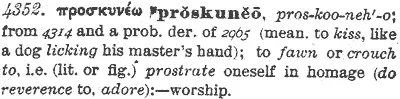
[Strong's Exhaustive Concordance of the Bible, James Strong, LL.D., S.T.D, 4352, p.61 of Greek-English Dictionary; actual scan]
That’s it. The end.
So even if Jochen wa
[sic] absolutely right that the word pros-kunew (προσκυνεω) has no etymological relationship to kuwn (κυων) for "dog" (which he is most definitely not), then this is not my "etymological fallacy" but it is James Strong's. Thus, the entire 15-page tirade which was based upon this point is rendered absolutely useless. Sorry, Jochen, but "dirty tricks get ya in the sticks".
That's it??? Not at all! As explained in the last section above, this was the pawn, and NOT the game.
Zaman claims regarding my first article that "the entire 15-page tirade which was based upon this point is rendered absolutely useless." That is completely wrong.
The part in which I discussed the etymology of proskuneo makes up merely 5.2% of my article (374 of 7232 words in the body of the article). I elaborated on the etymology only after I had already established the true meaning of the word, and after I had proven that Zaman had committed the etymological fallacy. The etymology discussion was an afterthought in the whole argument.
In other words, 94.8% of my article was not about the etymology of proskuneo but about about its contemporary meaning, and about various general and foundational linguistic principles related to and violated by Zaman's etymologial fallacies. This constitutes a rather low reading comprehension by any standard.
This is also further evidence that Zaman writes "rebuttals" without making the effort to understand the argument that he attempts to respond to.
I had made that already very clear in my article answering to his Talking Ants in the Qur'an?, exposing several of Zaman's straw men arguments. But seemingly he has not learned the lesson yet. Let me state it explicitly: I will not let Zaman (or anyone else) get away with misrepresenting my arguments.
If you care to respond to my articles, then deal with the actual arguments presented in them, and don't even think of building your case on knocking down a straw man. It will inevitably be exposed. "Dirty tricks get ya in the sticks"? Exactly!
[Question: Would Zaman care to clarify where he thinks I used a "dirty trick"? Or was that just another one of his many empty accusations that he cannot back up with any evidence?]
Apart from the obvious fact that Zaman is majoring on the minors and blowing this issue completely out of proportion, there are several further observations to be made about his above argument.
First, despite his confident conclusion, "That's it", Zaman has not presented any proof.
On the contrary, he only exposed that he has no clue what actually constitutes evidence in the field of etymology. He calls himself an etymologist, but is completely ignorant of the established methodology and accepted working standards in this field, and I am not talking about some deep aspect in the science of etymology that is only known to specialists.
Actually, I do not know of ANY field of studies where finding another person who shares your opinion constitutes proof that your opinion is correct.
From a scholarly point of view, it is not good enough to base your argument on ‘scholar X says Y’ (which would be the fallacy of appeal to authority). Rather you need to show why Y is true, and then use scholar X to back that up.
A correct approach would have been to thoroughly show how the words are related (providing examples from Greek texts to show this, e.g. tracking historical usages) and then one could have observed (say in a footnote) that Strong also makes the connection. But to start one’s argument from a reference to Strong's opinion is simply weak.
Second, we note that just as with his earlier introduction of the term tongue-in-cheek Zaman tries again to avoid taking personal responsibility for his errors.
He does not admit to any error, but just in case it should eventually turn out to be an error, then it is still not his error, but the error of James Strong.
Shifting the blame for an error to the higher authority of a textbook from which he copied it may perhaps be considered an acceptable excuse for a 7th grade highschool student.
Zaman, however, insists to be treated as a scholar of linguistics in his own right, and among scholars the attempt to defend a wrong argument with "but he said so" is impossible, not to say infantile. Zaman disqualifies himself through such behavior. [Furthermore, doing so is yet another logical fallacy, known as the fallacy of appeal to authority. As if Zaman hasn't already committed enough logical fallacies in this article alone.]
With the above attempt to shift responsibility Zaman has effectively ranked himself as being in a position way below Strong's in regard to linguistic authority. [Just how much of a linguistic authority Strong's is, will be discussed below.]
Let me give another illustration. For several years I taught undergraduate mathematics classes at university level. Even top students sometimes make mistakes and I had to give them a lesser grade on their homework or exam papers than they usually got.
Moreover, there are the not so good students who copy the work of good students and, in order not to be caught cheating, introduce slight variations in the formulation of their answers. Sometimes these variations make correct statements wrong, or slightly wrong statements become completely wrong because they did not really understand what they were copying.
The good student gets a "B" because of some mistake, the not so good student gets a "C" because he made that mistake even worse. He does not understand why his grade is less and thus he comes complaining and argues that he should get the same grade as the good student because he copied his work. Well, the result of such complaints can only be that the grade of Mr. not so good student drops from "C" to "F" for cheating. [If Zaman had been my student, he would probably have argued that he should get an "A", since this was not HIS mistake, but it was the mistake of the person he copied from! Frankly, I have heard too many silly excuses in my life. Sorry to disappoint you, but this approach won't work with me.]
I leave it to Zaman to decide whether he thinks that his above argument was more appropriately compared to the behavior of the textbook copying 7th grader in the first illustration, or better illustrated by the second one of the bad undergraduate student.
In any case, I have made my point. I will not let Zaman off the hook: As long as he poses as the "Near Eastern and Semitic Studies Institute of America" and makes public claims about his linguistic scholarship I will hold him personally responsible for all his linguistic mistakes.
Finally, while doing the research for my original article on Zaman's etymological errors, I discovered that Strong's Concordance indeed makes the connection between kuneo and kuon.
I was 95% sure that Strong's was the source of Zaman's claim. Being convinced that Strong is wrong regarding this conjecture, I had two options.
Either, I could quote Strong's entry on proskuneo, state why I thought that it was the source of Zaman's claim, and then proceed to explain why Strong is wrong in order to give Zaman no way of coming back on this issue (i.e., "slamming the door shut before it even opens", in Zamanian phraseology).
This would, however, have robbed Zaman of the opportunity to sling all these wonderful insults at me which we can now admire in his rebuttal, and it would have prevented him from displaying more of his deep linguistic knowledge — or rather the lack of it — as he has then done in manifold ways.
Four weeks before publishing my article, I discussed the ‘problem’ of Strong's entry with two people.
There were two reasons why I finally decided not to comment on Strong's in my first article. Strong's entry is merely an opinion without proof, it does not constitute evidence. Why should I make a long article even longer by discussing something irrelevant?
Zaman had not appealed to Strong's (yet), so there was no need to refute it. On the contrary, Zaman could then have accused me of a straw man argument, i.e. refuting what he never claimed. Moreover, after knowing my reasons to reject Strong's, Zaman would probably just have denied that this was indeed the source of his claims.
If I wanted him to reveal his source, then I had to make sure not to mention that I already knew it. [Chess is not the only discipline in which it is advantageous to think ahead a couple of moves.] Gladly, Zaman reacted just as expected on this one.
Zaman's abuse of Strong's
Let's have a closer look at what Strong's actually wrote and compare it with the conclusions that Zaman drew from this dictionary entry.
James Strong:
Shibli Zaman:
It is interesting to note that in the Greek text the word for "worshipped" here is "proskuneo" which is a contraction of "pros" meaning to "be in the manner of" and "kuneo" (root "kuon") which is basically a dog. How the Biblical translators understood groveling like a dog to be "worshipping" is dogmatically baffling to say the least. (Orig. article)
So even if Jochen wa absolutely right that the word pros-kunew (προσκυνεω) has no etymological relationship to kuwn (κυων) for "dog" (which he is most definitely not), then this is not my "etymological fallacy" but it is James Strong's. (His second article in defense of the first; added bold emphasis mine)
First, Strong only conjectured that the word kuneo is "a probable derivative of kuon". Zaman, however, simply skips the probability part and argues that this is definitely and unquestionably so. There is no expression of caution to be found in Zaman's statements. This is the first element of dictionary abuse on Zaman's part.
What is the evidence that led Strong to the conjecture that kuneo is derived from kuon? None is provided. Strong only stated a guess.
What is Zaman's additional evidence that allows him to argue this etymological connection not only as a conjecture but even with certainty? Zaman did not provide any evidence at all.
Second, Zaman's methodology of selecting several unrelated elements from a dictionary entry and then combining them into a new "meaning" (not found in the dictionary) is simply atrocious.
Let us first understand how Strong put together his dictionary entry before we examine how Zaman misused it. Strong clearly states that kuneo means to kiss, but since he feels (for unknown reasons) that kuneo is derived from kuon (dog), he then tries to connect the meaning "to kiss" with the word "dog" and comes up with "like a dog licking his master's hand".
After closing his parenthesis of etymological speculation, he does not mention the word "dog" again. Just as Strong knows that the meaning of kuneo is to kiss, so he knows also that the meaning of proskuneo is to "prostrate oneself in homage (do reverence to, adore)" and it is usually and correctly translated in the KJV as "worship". However, Strong's fondness of his conjectured root word kuon has seemingly led him to seek a couple of words that can be used of both dogs and humans, and so he inserted into his list of meanings also "to fawn or crouch to" (as connecting elements between root and meaning?) before providing the real meaning of proskuneo after "i.e. (literally or figuratively) ...".
[This is part of the reason why the little dictionary of Strong's Concordance is not considered a scholarly resource. It was not put together in a scholarly manner but contains much unfounded speculation.]
Nevertheless, Strong is careful not to mention dogs explicitly in his given list of meanings. His dictionary entry does not state that proskuneomeans and should be translated as "to crouch like a dog" or anything of that sort. He was apparently aware that there is no basis for this, not knowing of any text in which this word is used in such a meaning. [More about this in the section about the proper methods of how an etymology is established.]
Such caution is, however, foreign to Zaman. He has no hesitation to select one part from Strong's parenthesis of conjectural etymology (i.e., "like a dog") and to combine it with one of the meanings. Since in English one does not usually say that dogs "prostrate", he searched for a word which would convey the same idea of prostrating, yet a term more appropriately used for dogs, namely "groveling". Therefore, according to Zaman, proskuneo now means "groveling like a dog".
[ Note: My above attempt of reconstructing Zaman's ‘thought process’ is obviously guesswork. Actually, this scenario is still giving him some benefit of the doubt. When taking his statements at face-value then his steps for arriving at "groveling like a dog" seem to be even worse: He is turning prepositions into verbs, verbs into nouns etc., see my analysis in the first article. The meaning that Zaman claims for ‘pros’ does not even have a basis in the Greek Dictionary of Strong's Concordance (No. 4314) but is completely off the wall. ]
Yet, this is not all. By stating, ‘How the Biblical translators understood groveling like a dog to be "worshipping" is dogmatically baffling to say the least’, Zaman actually denies that "worship" is at least one meaning and correct translation of proskuneo.
With this step Zaman went not only way beyond Strong's but lost the support of each and every dictionary of the Greek language. This is the second element in Zaman's abuse of Strong's dictionary.
Third, Zaman's above statement confirms again that he has no idea what the ‘etymological fallacy’ is, despite posing as a scholar and researcher of etymology. The concept of an etymological fallacy was explained and discussed at great length in the first part, and is now assumed as understood.
James Strong simply stated his conjecture that kuneo (κυνεω) is probably a derivative of kuon (κυων). This may be a wrong etymology (and thus an error of fact) but it is not the etymological fallacy.
The etymological fallacy is assuming that the root meaning of a word is to be used in exegesis — despite the fact that the so called ‘root meaning’ was not in the mind of the user (writer or speaker) of the word.
James Strong did not say that we should bring dogs into understanding the NT use of proskuneo. Even though James Strong's dictionary entry is hardly an example of careful and responsible scholarship, he was still able to distinguish between the real or conjectured etymology of a word and its actual meaning.
It was Shibli Zaman alone, who explicitly imported the alleged etymon kuon (dog) into the current meaning of the word and claimed that proskuneomeans "groveling like a dog" (and that this alone is its real meaning). Therefore Zaman alone is guilty of the etymological fallacy (not Strong) and, worse, he does not even know what said fallacy actually is. This bears repeating since it is so essential: Zaman alone has committed the etymological fallacy while Strong has simply made an error in his supposed etymology. These are two entirely different errors since even if Strong was right, Zaman would still be in error.
The above statement about Strong is actually unfair because it does not take into account the historical context.
Let me therefore reformulate: By modern standards, Strong's dictionary seems not to be an example of careful and responsible scholarship. However, James Strong did not have the benefit of all we now know about linguistics.
Zaman, on the other hand, does have the benefit of the discipline of modern linguistics and, furthermore, claims to be a skilled practitioner. There is no excuse for him on these grounds.
Is Strong's a scholarly resource?
On the very same day that Zaman appealed to Strong's Concordance as proof for his claim regarding the etymology of proskuneo he also published a second rebuttal article in which he dismissed Sam Shamoun's quoted sources with this reasoning:
II. Scholarly vs. proletarian evidence
Mr. Shamoun proceeds:
"According to Greek Grammarian William D. Mounce: 'There is ...' (Basics of Biblical Greek Grammar [Zondervan Publishing House: Grand Rapids, MI 1993], p. 302; ...)"
It is unfortunate for Mr. Shamoun who appealed to it, Basics of Biblical Greek Grammaris a very novice textbook. With all due respect to its author, it is not an exhaustive reference for Greek grammar by any stretch.
Although Shibli Zaman has apparently great problems in distinguishing what is a scholarly resource, and what not, and in selecting the appropriate scholarly reference for those linguistic questions he chooses to discuss, the question whether a certain reference is scholarly and trustworthy is certainly important. This section is, therefore, devoted to determine whether Strong's is generally considered a scholarly resource or not.
First, one needs to take seriously the full title of Strong's, i.e. Strong's Exhaustive Concordance of the Bible. Even though this book also has an appendix with a small Hebrew-English and Greek-English dictionary, Strong's is first of all a concordance of one particular English translation of the Bible, the King James Version. It was never designed to be a serious Greek or Hebrew dictionary.
It is not a lexicon and it is no real guide to etymology or morphology. At the time of its publication in 1890 this concordance was a momentous achievement and it is still very useful as a concordance. But if one needs to consult a dictionary one should look elsewhere.
For background information on the problem of "etymology in old dictionaries" let me begin with this quotation:
ETYMOLOGY
is word history. The etymology of a word is its history from its beginnings, including its forms and its meanings as far back as these can be documented and its record of being borrowed and adapted into other languages. As etymologists bring the record forward or trace it backward, they try where they can to explain whatever linguistic and semantic change they encounter. Although science is a necessary part of it, etymology is finally as much art as science, and many of today’s dictionaries have been obliged to substitute the more accurate comment "origin unknown" for what were once thought to be good guesses at the etymology of many words. Likely possibilities are simply not the same as proofs. (Kenneth G. Wilson, The Columbia Guide to Standard American English, Columbia University Press, 1993; online source; bold emphasis mine)
We have already seen that Strong injected much speculation and guesswork in his entry on proskuneo. This is a serious problem throughout his little dictionary and has led to many abuses ever since its publication. There is not only the problem of people who abuse it for polemical reasons like Zaman, but also many honest and devoted Bible students without linguistic training have been led astray by taking up Strong's etymological speculations and pushing them into their exegesis, thus committing the etymological fallacy over and over again.
Strong's dictionary methodologies are flawed by what has come to be called "root fallacy." He assumed that biblical words could be defined by the sum of their parts. But we know that a pineapple is not an apple that grows on pine trees, nor is a butterfly a fly that lives in butter. Our dictionaries are based on the latest lexicons and word studies, reflecting the significant advances in biblical scholarship of the past half century. And The Strongest Strong's is the only edition to contain up-to-date Greek and Hebrew dictionaries. (bold and underline emphasis mine, this paragraph as scanned image, original source[1 MB file size!])
A similar statement is also found under the heading "Improvements in the Strongest Strong's", in the Introduction of this edition. Since Zaman has such a bad track record regarding understanding things the first time around, ... let me quote this slightly different formulation as well:
Fourth, Strong's dictionaries are flawed by a methodology of the nineteenth century that has come to be called the "root fallacy." He assumed that biblical words could be defined by the sum of their parts. But just as we do not think that a pineapple is an apple that grows on a pine tree or that a butterfly is a fly that likes butter, so we should not use this methodology to define biblical words as was so common in the nineteenth and even the twentieth centuries.Our dictionaries are based on the latest dictionaries, lexicons, and word study books, reflecting great advances in biblical scholarship. (Source: The Strongest Strong's Exhaustive Concordance of the Bible, 21st Century Edition, by James Strong, LL.D., S.T.D., fully revised & corrected by John R. Kohlenberger III and James A. Swanson, Zondervan, 2001, p. x; bold and underline emphasis mine, actual scanned image)
The following is the dictionary entry on proskuneo from this new edition:
[Op. cit., Greek Dictionary-Index to the New Testament, p. 1528]
The word definitions are present but none of Strong's unfounded etymological speculations. The entry states now exactly what is found also in the scholarly dictionaries LSJ and BDAG. No mention of dogs is found in this corrected edition.
Since Zaman did not even accept my quotations and arguments based on the scholarly dictionaries that I had cited in my original article, he is unlikely to accept the entry from a revised Strong's Concordance as the final word. After all, this new dictionary is still a laymen's tool and not an exhaustive scholarly resource although it is much more accurate than Strong's original version.
The next section will therefore provide a quotation from the standard reference on the etymology of Greek words.
/p>
Excursus:
What about those books advocated by Zaman himself? After dismissing Mounce's book as "proletarian",
Herbert Weir Smyth's original 1920 edition of A Greek Grammar for Colleges that Zaman quoted from has an "Appendix: List of Verbs" and states in the section "Verbs beginning with kappa":
ku-ne-ô (ku-) kiss: kunêsomai (?), ekusa. Poetic.
pros-kuneô render homage to: pros-kunêsô, pros-ekunêsa (pros-ekusa poetic). (IV.) (Attic)
[Online Edition made available in the Perseus Project of Tufts University]
And the revised edition of this book says still the same:
[Herbert Weir Smyth and Gordon M. Messing, Greek Grammar, rev. ed. Cambridge: Harvard University Press, 1972, p. 704]
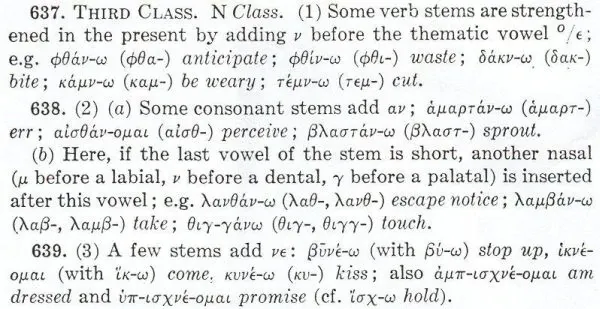
None of the books recommended by Zaman as being authoritative standard references make any connection between kuneo (kiss) and kuon (dog). On the contrary, both books give (κυ-) and not (κυν-) as the stem or root of the verb, i.e. without the letter nu (ν) which would have been necessary if the word were derived from kuon (genitive case: kun-os).
The way that Smyth hyphenates the word ku-ne-o in order to clearly display the various elements of it, shows that -νε- is an infix and not part of the root. The reason that Goodwin and Smyth only give (κυ-) instead of (κυσ) as root may be that σ, the final letter of the root, is not visible but contracted away in the present tense. One can even find that Goodwin explicitly discusses the construction of present tense of the verb kuneo (κυνεω) in the text of his book:
[William Watson Goodwin, Greek Grammar, p. 156]
Thus, according to Goodwin, the syllable νε in the middle of the verb κυνεω is an infix inserted for the purpose of strengthening the verb stem in the present tense. But it is not part of the root of the verb. More details will be provided about this in the next section. If Zaman had been able to understand the books that he refers to, he could have avoided this error and saved himself much embarrassment.
Serious dictionaries are made for people who have learned the principles and rules of a particular language, who may still need to look up the precise meaning of a word but who know what to do with the information provided by the dictionary. Scholarly dictionaries of Greek neither transliterate words nor do they give a pronunciation guide for each entry because they assume that the user can read the Greek entries (i.e. knows the Greek alphabet) and has learned how to pronounce Greek words. Let's look again at just the first line of Strong's entry on προσκυνεω:
Strong's is a ‘dictionary’ for people who do "Greek by numbers" because they know nothing about the language, not even the most elementary basics like the alphabet (thus the need for the transliteration proskuneo) or the pronunciation rules (thus the pronunciation help pros-koo-neh'-o). The very fact that Zaman uses and appeals to Strong's is another indication that that he most likely never attended even a beginners' class of Greek, let alone being a qualified scholar.
James Strong was a good theologian and has published a number of valuable books. His concordance of the KJV was a monumental achievement in its time (1890), but the Hebrew and Greek dictionary appendix shows that linguistics was not his strongest point. In college and university level courses for learning either Classical Greek or Biblical Greek, (the dictionary appendix of) Strong's Concordance will usually not even be mentioned as a possible dictionary; it is simply not admissible. I dare say, Zaman will most likely not be able to find even one Greek language course at an accredited institution for which the bibliography of course books recommends Strong's Concordance as a dictionary. It is certainly not listed on these resource pages: INTER LIBROS: Gateway for Classics and Medieval Studies Research at Harvard; it is neither listed under Greek and Roman Materials: Secondary Sources of the Perseus project at Tufts University, nor in this graded list of
On the contrary, since the use of Strong's is so widespread among Christians who have not learned the biblical languages, seminary instructors even warn their students about the problems associated with using Strong's:
Word Study Fallacies
Lexical fallacy – ...
Root Fallacy – This particular fallacy is perhaps more common in Hebrew
studies than in Greek. But it can be found in New Testament studies. This
fallacy assumes that behind groups of words in the NT is a root word whose
essential meaning can be traced in all of the words that derive from that
root. This is to see the meaning of words as coming from their etymology. A
similar fallacy comes when studying a compound word i.e. a word that is made
up of 2 or more meaningful components. Some break the words up into those
components and try to derive the meaning from those components. The
absurdity of doing this is seen in a word like butterfly. We simply cannot
correctly deduce the meaning of butterfly by reflecting on the meanings of
"butter" and "fly."
A number of very commonly used tools for NT study repeatedly fall into this
fallacy. The meanings given for Greek and Hebrew words in the back of Strong's
concordance are full of root fallacies. Some standard older works fall into
the same problem. The works of Wuest, Thayer and Vine need to be used with much
caution. It is not that all that they say is wrong. However, they are so
frequently guilty of this fallacy and the first one that I do not consider them
reliable guides. The best guides to word meanings are found in the standard
dictionaries. For the OT that is the one by Brown, Driver and Briggs and for
the NT it is the lexicon by Baur, Arndt, Gingrich and Danker.
(Source: Article on
Word
Study by Steven C. Ibbotson, Prairie Bible Institute)
This does not mean that everything in the dictionary appendix of Strong's Concordance is wrong, but this work is not only outdated, it is seriously flawed. If anyone derives an idea from some statement found in Strong's, but cannot substantiate it through reference to a scholarly resource, he would be better off not making public claims about it at all.
In Zaman's choice of words, Strong's Greek Dictionary is definitely proletarian evidence:
II. Scholarly vs. proletarian evidence
... It is unfortunate for Mr. Shamoun who appealed to it,
Basics of Biblical Greek Grammaris a very novice textbook.
With all due respect to its author, it is not an exhaustive reference
for Greek grammar by any stretch.
Zaman dismissed a respectable textbook because it was written for the beginning student. His appeal to Strong's Concordance as proof for his wrong etymology and the way he abused this dictionary are, however, strong evidence that he is not even a beginner himself. If Zaman had learned only as much Greek as is taught in Basics of Biblical Greek Grammar he would not have made many of the errors we now have to deal with in this discussion.
Actually, the issue is not whether a source is proletarian or scholarly, but whether the statement it makes constitutes evidence. Dismissing an argument as proletarian is the ad hominem fallacy all over again, and doing so is not scholarly behavior but merely arrogance. Cited evidence needs to be evaluated regarding its truth, although sometimes origin does determine credibility. If Strong's had provided actual evidence for Zaman's claim, then I would have taken it seriously despite the generally non-scholarly character of this dictionary. However, as already noted, for the issue under discussion Strong's provided only speculation and no evidence at all.
The essential question now is: What does constitute evidence for a claim regarding the etymology of a word or expression? This is the topic of the next section.
Etymology
Establishing the etymology of a word
So far, Zaman has presented no evidence to support his claim that kuneo was derived from kuon, let alone that its original meaning is associated with dogs, i.e. he has argued nothing more than "these words look somewhat similar therefore they are derivatives of each other" and a citation of Strong's who seems to have held to the same unfounded opinion. This hardly constitutes scholarly evidence.
How is a meaning or how are the meanings of a word established? A word has a certain meaning only when we find a text in which the word is used in this meaning. If no reference exists in which a word is used with the conjectured meaning, then there is no evidence that it actually ever meant this. "No reference? No meaning!" Period.
How are scholarly dictionaries made? Before a certain meaning is listed in a dictionary entry, there needs to be established an actual occurrence of the investigated word with this meaning. For example, here are two articles from the Oxford English Dictionary website: New Words - how do they get into the dictionary? and Revising a Dictionary. This procedure is the same for modern as well as classical languages. Only documented meanings will be included in a scholarly dictionary. If speculation about the meaning of a word would be enough, dictionaries would soon become useless.
Regarding the etymology of words, the same site states:
There are many terms for which 'folk etymologies' are in wide circulation.
Some of them are merely whimsical inventions; others are very plausible,
and the only thing that prevents them from being given in the dictionary is
the need for proper linguistic and historical evidence. Simply sounding
plausible is not enough - the histories of words presented in dictionaries
are based on the principles of etymology, and are supported
by linguistic and historical evidence. Also limited space in dictionaries means
that there is little room to explain why favourite stories are etymologically wrong.
(On ‘Folk Etymologies’; emphasis mine)
What are the 'Canons of Etymology'? [Extract from W. W. Skeat's Etymological Dictionary
of the English Language (2nd edition, 1883), chapter xxiii.]
In the course of the work, I have been led to adopt
the following canons, which merely express well-known principles,
and are nothing new. Still, in the form of definite statements, they are
worth giving.
Before attempting an etymology, ASCERTAIN the earliest form and use
of the word; and observe chronology. ...
The whole of a word, and not a portion only, ought to be reasonably
accounted for; and, in tracing changes of form, any infringement of phonetic
laws is to be regarded with suspicion.
Mere resemblances of form and apparent connection in sense between
languages which have different phonetic laws or no necessary connection
are commonly a delusion, and are not to be regarded. ...
It appears that connecting verb kuneo (kiss) with kuon (dog) is just one such unsustainable ‘folk etymology’. The fact that it did not originate with Shibli Zaman does not make it any more credible.
Dr. Weekley, a renowned linguist and etymologist (1865-1954),
devised the following test for determining the veracity and accuracy of any given
etymology:
The etymology must start from the earliest or most fundamental sense of the word
The etymology must not violate the recognized laws of sound change
Each change in the word, whether in form or in meaning, MUST BE clearly TRACED.
The following excerpt is short and to the point since it shows that the Islamic deity is nothing other than a finite, temporal humanoid figure who resembles the pagan gods rather than the one true God of the Holy Bible:
34 - Abdullah ibn Sulayman ibn al-Ash'ath al-
Another Islamic Dilemma!
Sunni Islam teaches that the Quran is the uncreated speech of Allah that emanates from him. At the same time, the Quran teaches that there is a mother of the book from which it originates:
We verily, have made it a Qur'an in Arabic, that